
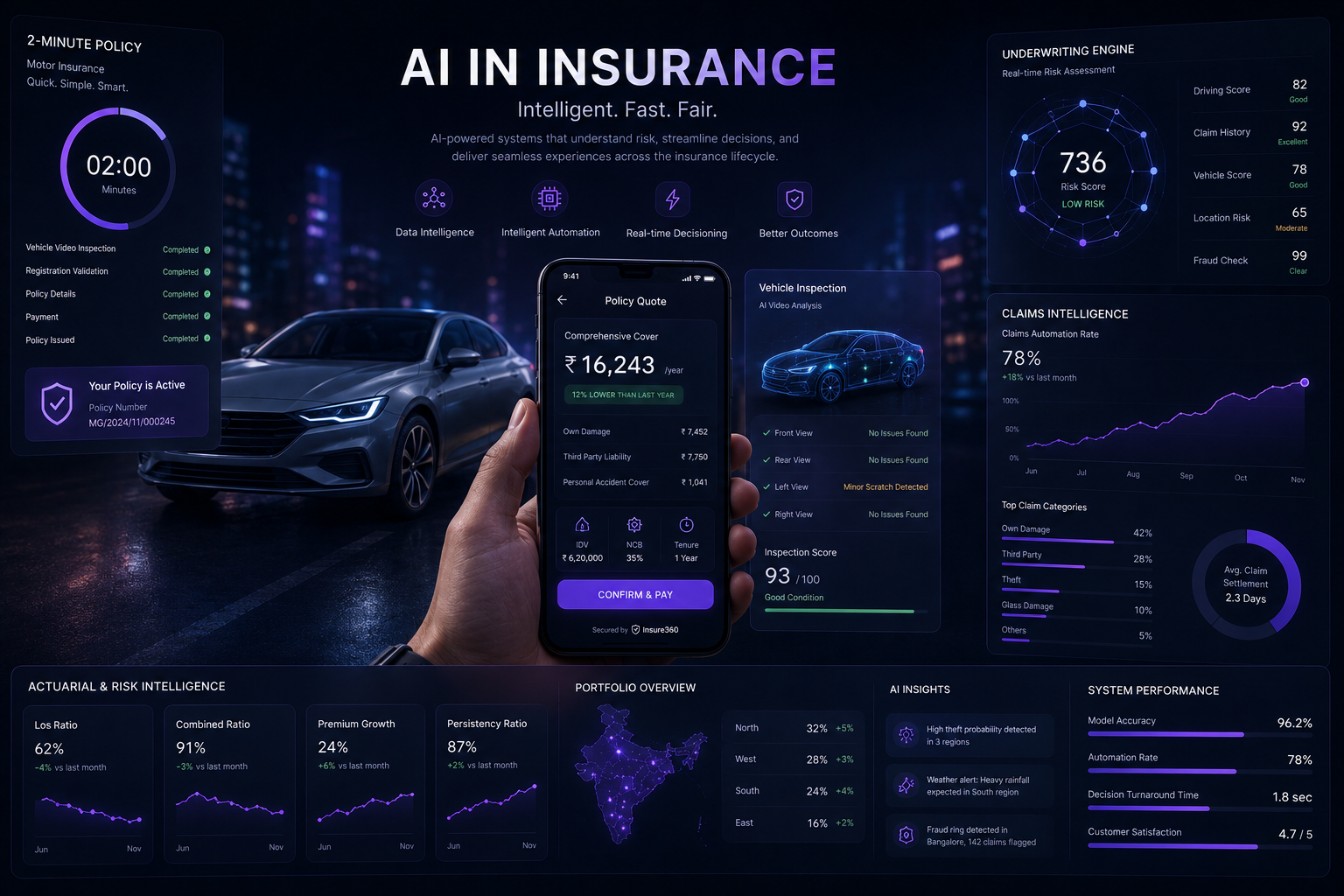
A two-minute purchase
A motor policy purchase that, ten years ago, took most of a Saturday morning, with a printed proposal form, a branch visit, and a surveyor walking around the car with a clipboard, now takes a little under two minutes on a phone.
The buyer films their car from four prescribed angles, the application picks up the registration details from the database in the background, the premium is quoted, and the policy is bound.
Nobody employed by the insurer has spoken to the customer or seen the vehicle.
None of the calculations behind the price have changed in any fundamental way.
What has changed is everything around them.
This is the visible face of artificial intelligence in insurance, and it is by some distance the least interesting part.
The harder, slower, more consequential changes sit behind the quote: in how the insurer decides what to charge, who to insure, when to pay, and how to talk to people through the long tail of small interactions that make up an insurance relationship.
Insurance has always been an industry built around pricing the unknown.
For more than a century, it priced the unknown using two tools: statistics, in the form of actuarial tables and loss data, and paperwork, in the form of forms, medical reports, surveyor notes, and signed declarations.
Both tools work.
Both have well-understood limits.
AI does not replace either.
It fills the gaps where statistics cannot see and where paperwork cannot keep up.
The shape of the industry, briefly
A premium pays into a pool.
The pool pays out claims.
The insurer's job is to ensure, on average and over time, that the premiums collected exceed the claims paid plus the cost of running the business.
Underwriting decides who can join the pool, and at what price.
Claims decide who gets paid, when, and how much.
Almost every AI application in the industry is a refinement of one of those two activities, plus the customer-facing layer that sits on top of both.
The industry is conventionally split into two halves.
Life insurance covers long-duration risks such as death, critical illness, and disability, and is often blended with savings or investment components.
Policies run for decades, premiums are typically level, and the insurer is making bets on a person's future health and longevity that will not be settled for years.
General insurance, also called non-life, covers shorter-duration risks: motor, health, property, marine, liability.
Policies usually run for a year, are repriced at renewal, and turn over claims in volume.
This split matters because the AI opportunities look different on each side.
Life insurance is data-poor per customer but high-stakes per decision.
The same underwriting decision sits on the books for thirty years.
General insurance is data-rich, decision-frequent, and physical: vehicles, hospitals, buildings, weather.
The first asks AI to extract more meaning from limited information.
The second asks AI to handle volume, speed, and the messy world of cameras, sensors, and documents.
Life insurance: where the actuarial math runs out
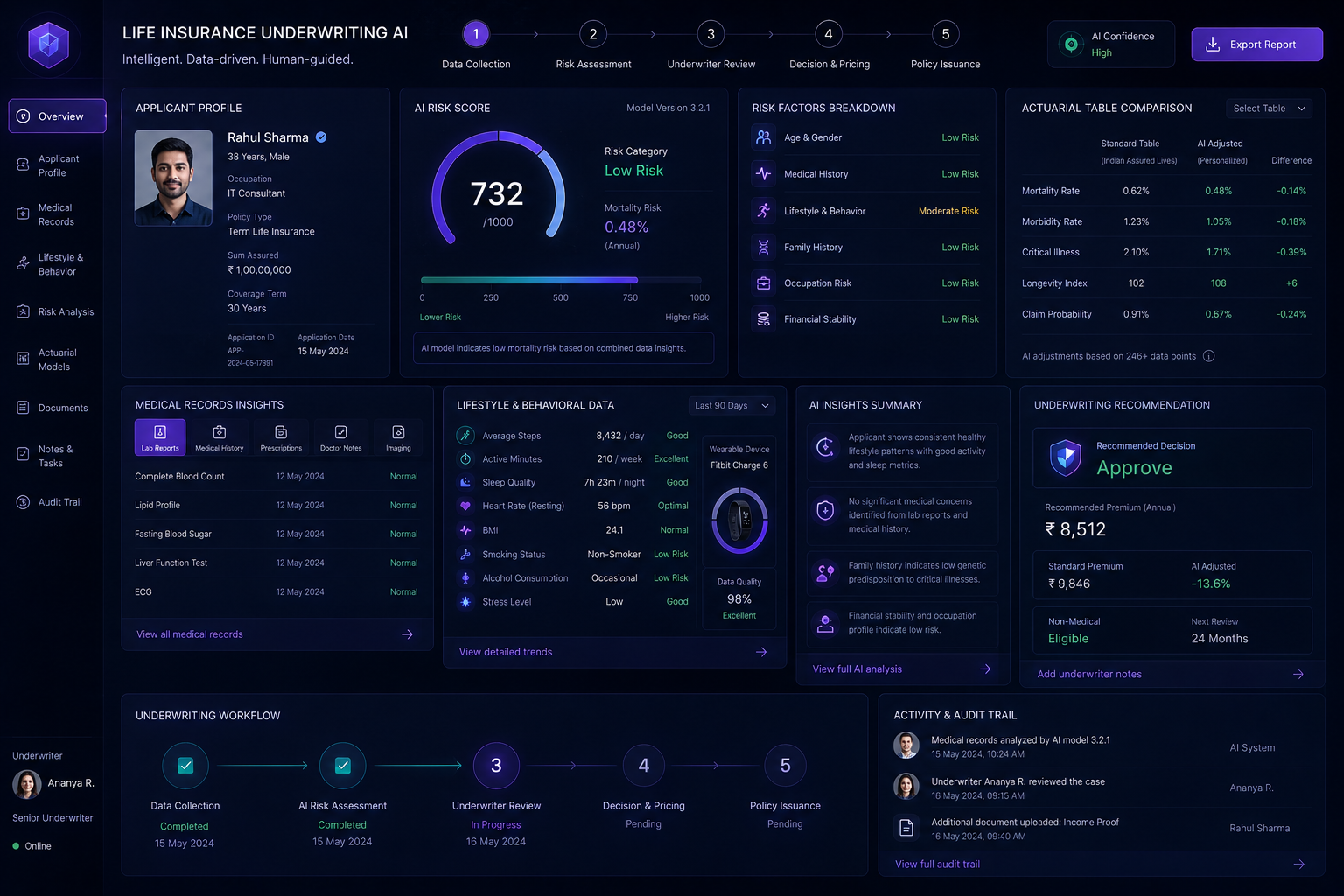
Life underwriting is, in its current form, almost purely mathematical.
An applicant's age, sex, occupation, smoking status, height-to-weight ratio, declared medical history, and a spot medical examination feed into actuarial tables that price mortality with respectable accuracy at the population level.
The math works.
It has worked for over a century, and it will continue to work.
Its limits, however, are well-known to anyone who has spent time inside a life insurer.
There are three of them in particular.
The first is that underwriting is a static snapshot.
A policy is priced at issuance based on what is known on that day, and then the contract runs for twenty or thirty years during which the insured's life changes in ways the insurer never sees.
Someone who took up smoking after issuance, or whose blood pressure drifted upward over a decade, is paying a premium that no longer reflects their risk.
The reverse is also true.
A customer who quit drinking, lost weight, and started running half-marathons is overpaying.
The pricing is correct for the average case.
It is wrong for almost every individual.
The second is that nearly all the inputs are self-reported.
Lifestyle, family history, drinking and smoking habits, prior diagnoses: all are declared on the proposal form and verified, if at all, only spottily.
The medical examination catches some misrepresentation but is itself a single point in time and limited in scope.
The industry has lived with this uncomfortably, pricing in an assumed level of misstatement.
The third is that the most informative parts of an applicant's medical history arrive as unstructured paragraphs of text.
Discharge summaries, prescription histories, doctor's notes, pathology reports: these are documents written by clinicians for other clinicians, full of abbreviations and judgement calls.
Underwriters skim them under time pressure.
Two underwriters reading the same file will not always reach the same decision.
AI addresses each of these gaps, with varying degrees of maturity.
Medical documents, behaviour, and continuous risk signals
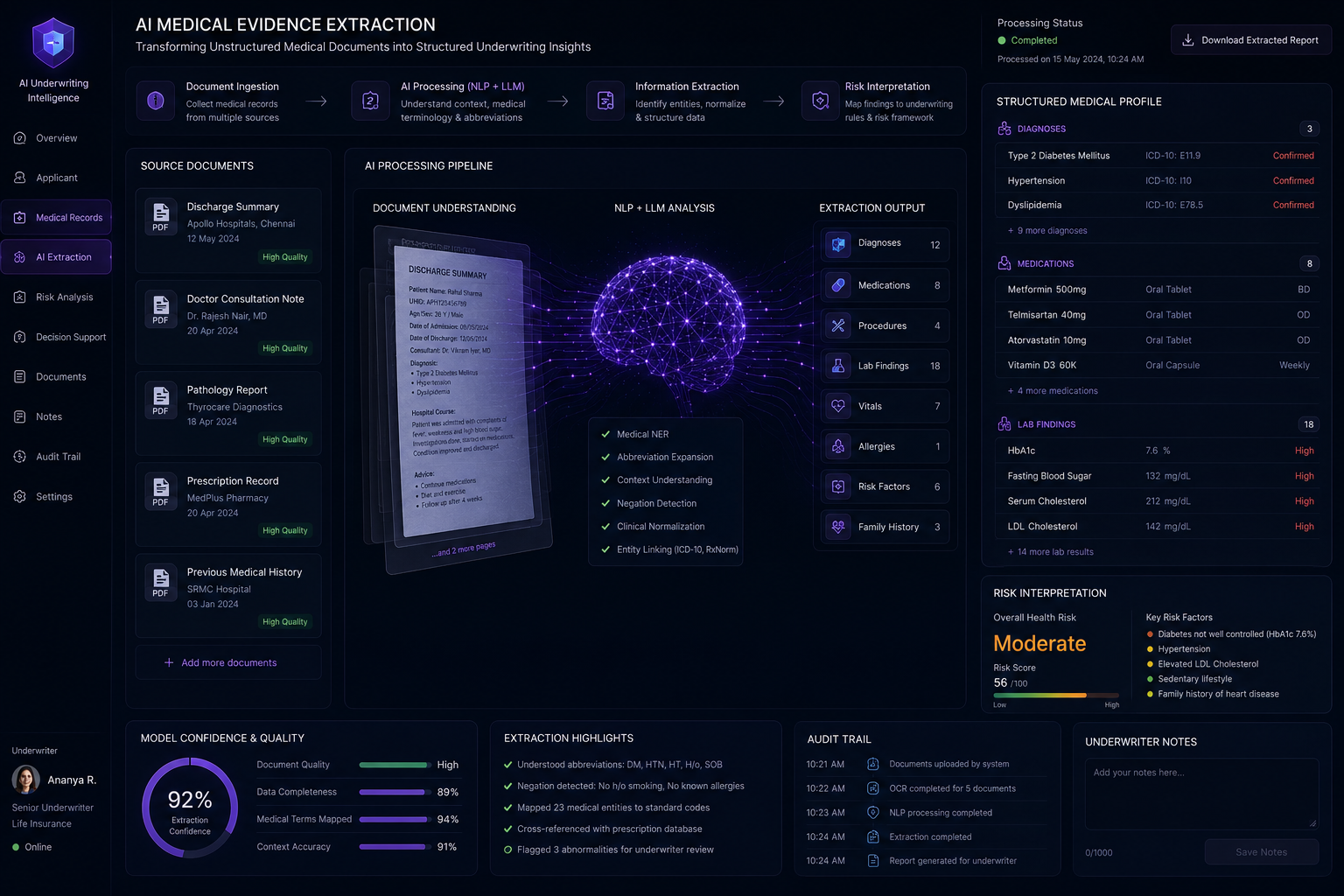
Continuous and behavioural underwriting moves the snapshot into something closer to a video.
Smartphone-derived activity data, voluntary wearable integrations, and lifestyle apps allow the insurer to maintain an updated view of an insured's health behaviours over the policy term.
The information is rarely used to reprice in a hard sense.
Most jurisdictions, including India, do not allow life premiums to fluctuate freely after issuance.
But it powers reward structures, wellness incentives, and renewal-time decisions on add-on covers.
In practice, this is most developed in markets like South Africa, the United States, and parts of East Asia.
Indian insurers are at an earlier stage but moving in the same direction.
Natural language processing, particularly using large language models, has changed the economics of unstructured medical evidence.
A model that can read a stack of discharge summaries and output a structured list of diagnoses, medications, comorbidities, and severity flags lets a human underwriter spend their time on judgement rather than transcription.
The accuracy is not perfect.
Clinical NLP has well-documented failure modes around abbreviation ambiguity and handwritten notes.
But the productivity gains are large enough that most well-resourced life insurers are running pilots or production deployments today.
Accelerated underwriting, where low-risk applicants skip the medical examination entirely, depends on combining traditional answers with alternative data such as prescription history, credit-like behavioural signals, and public records to arrive at a confident risk view without the friction of a clinic visit.
The Indian market has moved unevenly here.
Consent and data-availability constraints are different than in the United States, but the account-aggregator framework and the maturing prescription-data ecosystem are filling in the gaps.
Lapse and persistency modelling sits slightly outside the underwriting frame but matters at least as much commercially.
Persistency is the fraction of customers who keep paying premiums year after year, and Indian life insurance has historically struggled with it.
A policy that lapses in year two is a loss-making policy, regardless of how well it was priced at issue.
Models that predict which customers are about to drop a policy, and trigger a phone call or a reminder before they do, have measurable returns and have become standard in the back office of most large life insurers in India.
General insurance: shorter cycles, more touchpoints
General insurance reprices every year, settles claims constantly, and lives in the physical world of cars, hospitals, buildings, and weather.
That makes it the natural home of computer vision, IoT, and document-heavy automation, and the place where AI's effects on operating costs are most directly measurable.
Three patterns recur across all the sub-domains.
Customer profiling has shifted from broad demographic segmentation toward behavioural micro-segmentation.
App and web telemetry, transaction patterns, and consented third-party data allow an insurer to price more granularly than the traditional age-and-postcode bucket.
The improvement in pricing accuracy is real, though it raises the fairness questions that the closing section returns to.
Customer interactions follow the same conversational-agent pattern as life insurance, but with simpler and more frequent touchpoints.
Renewals, endorsements, claim intimation, hospital pre-authorisation status: these are short, structured conversations that fit conversational AI well.
The economics are also better.
A policy that costs eight thousand rupees a year cannot support the same human-touch service as one that costs eighty thousand, so automation is doing real work in keeping general insurance commercially viable at the small-policy end.
Fraud detection has been transformed by graph-based pattern recognition.
A single suspicious claim might be invisible to an adjuster.
A cluster of claims sharing repair shops, surveyors, doctors, or claimants is harder to hide once the data is structured as a network.
Most large insurers now run continuous graph analytics on their claims data, surfacing rings of collusive activity that would have been impossible to detect manually.
The investigations are still done by humans.
The targeting is done by models.
Motor insurance: cameras, telematics, and the end of the garage visit
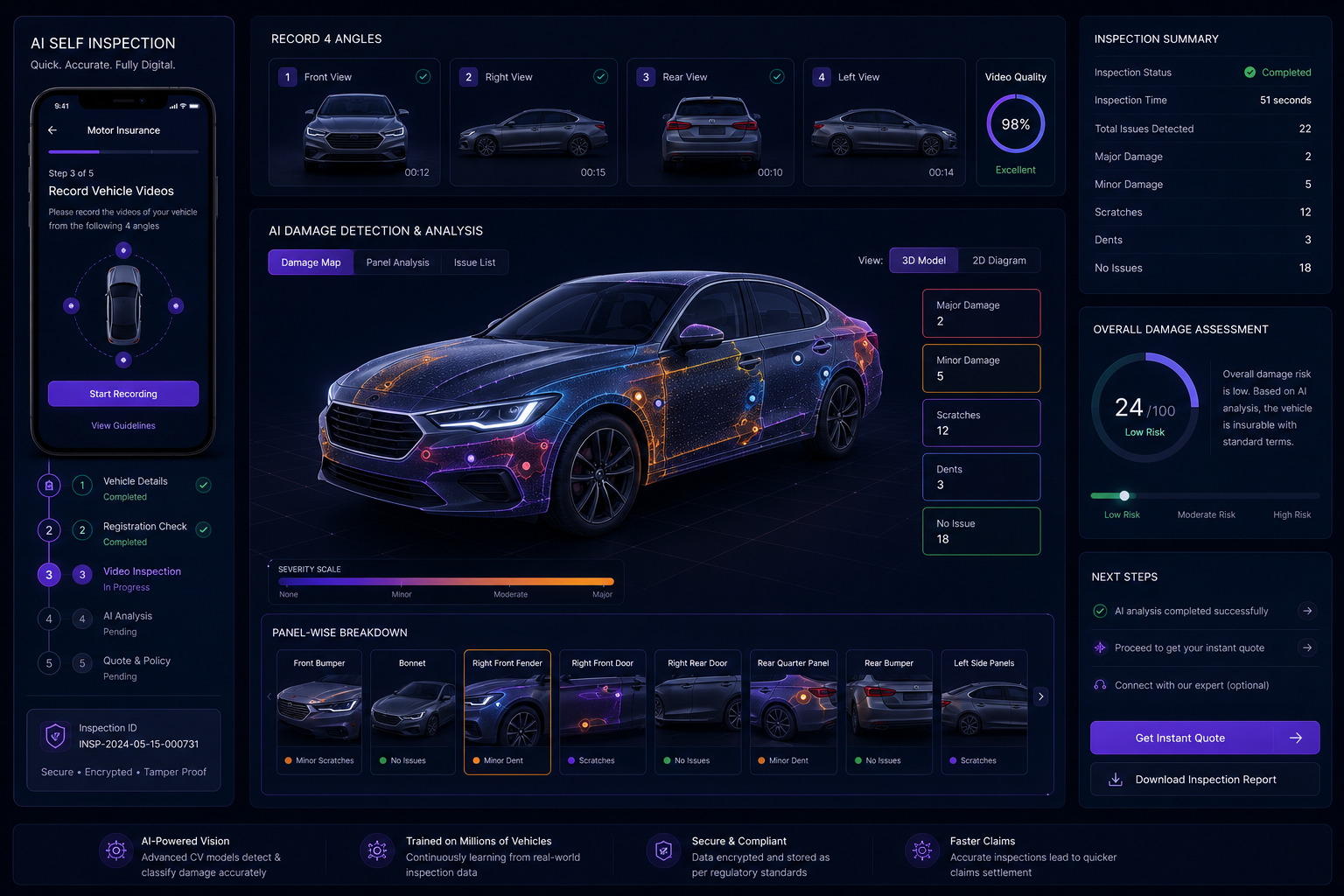
Motor is the sub-domain where AI's effects are most visible to the customer, because they have removed friction the customer used to feel.
Pre-policy inspection has historically been the largest single source of friction in motor renewals.
A customer whose policy lapsed even briefly was required, in most cases, to take the vehicle to a designated garage so that an inspector could verify its condition before a fresh policy could be bound.
The process took days.
A material number of customers, faced with the inconvenience, simply moved to the cheapest available alternative, or drove uninsured for a period.
Computer-vision-based self-inspection, where the customer films the vehicle from prescribed angles on a phone and a model assesses pre-existing damage panel by panel, removes the garage visit.
The customer experience is a one-minute video.
The underwriting experience is a structured damage report.
The technology has been in production in Indian motor insurance for several years now, and the cost per inspection has fallen by an order of magnitude.
Edge cases remain: uncommon vehicles, unusual angles, poor light.
Most insurers retain a human review queue for low-confidence cases, but the routine majority is handled automatically.
Motor claims and telematics
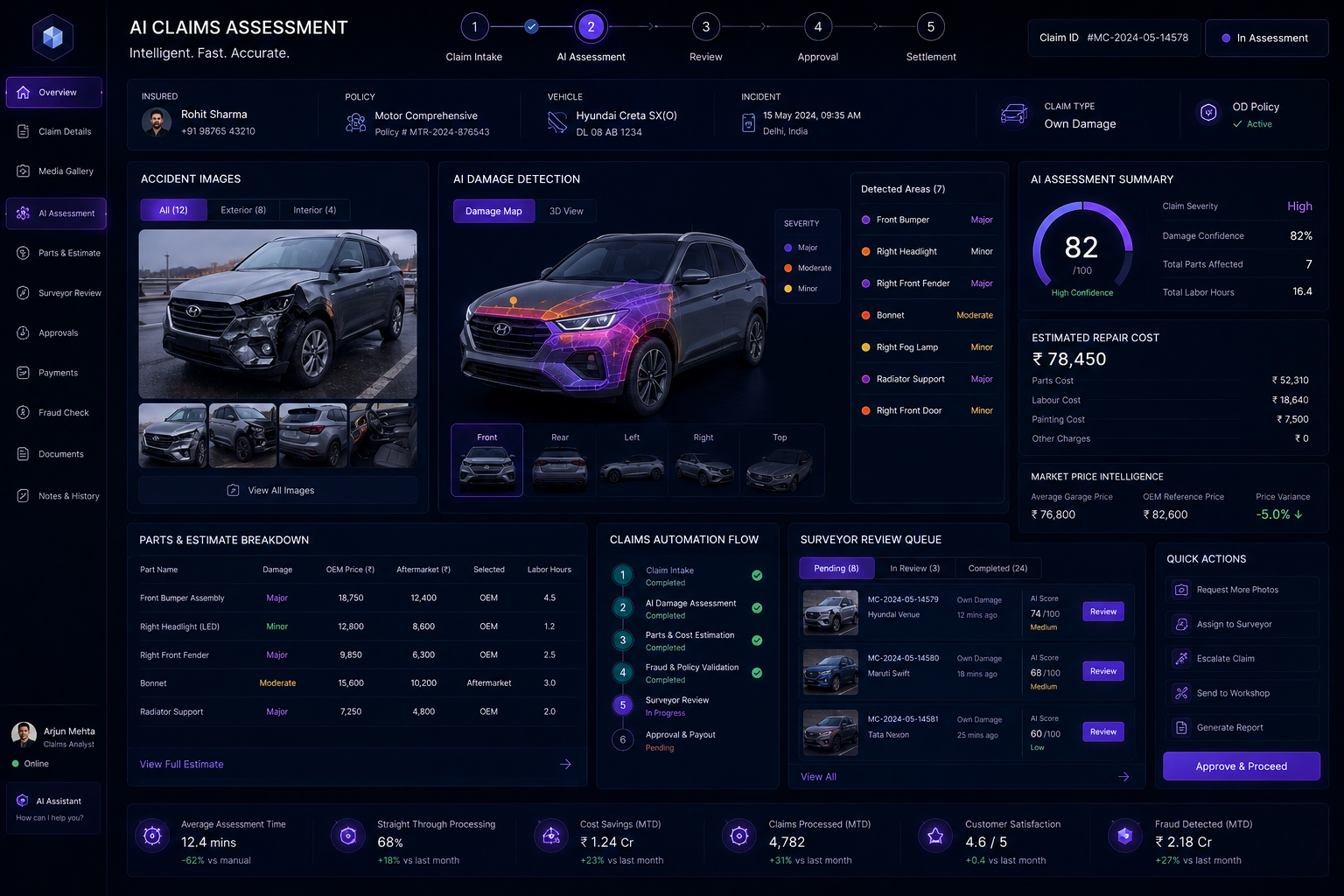
Loss assessment after an accident has followed a similar trajectory.
Photos and video of the damaged vehicle feed a model that estimates severity, identifies likely parts replacements, predicts repair cost, and flags probable total-loss cases.
Combined with a network of garage pricing data, an insurer can pre-approve a routine claim before a surveyor arrives on site.
The surveyor's role, for the cases where they are still dispatched, has shifted toward verification and the harder edge cases such as flood damage, internal mechanical loss, and complex multi-vehicle accidents, rather than first-pass assessment.
The framing of this shift inside the industry tends to be that AI handles the routine eighty per cent and humans handle the interesting twenty.
That is broadly correct, with the qualification that the routine eighty per cent is also where the volume, the cost, and the customer-experience pain previously lived.
Proposal risk assessment is where motor insurance is most clearly heading toward continuous, individualised pricing.
Telematics, meaning driving-behaviour data captured from the vehicle or from the driver's phone, allows an insurer to price how someone actually drives rather than what their demographic profile suggests they might.
Hard braking, late-night driving, route choice, and acceleration patterns are all useful signals.
The Indian market has the unusual feature that most cars do not have factory-fitted telematics, which would normally be a constraint.
Smartphone-based capture, with consent, has filled that gap.
The data quality from a phone in a cup-holder is, for most pricing purposes, sufficient.
A small but important caveat: telematics-based pricing remains regulated, and the structures permitted vary by jurisdiction.
The direction of travel is clear, but the pace is set by regulators rather than by what the technology can support.
Health insurance: matching cover to need
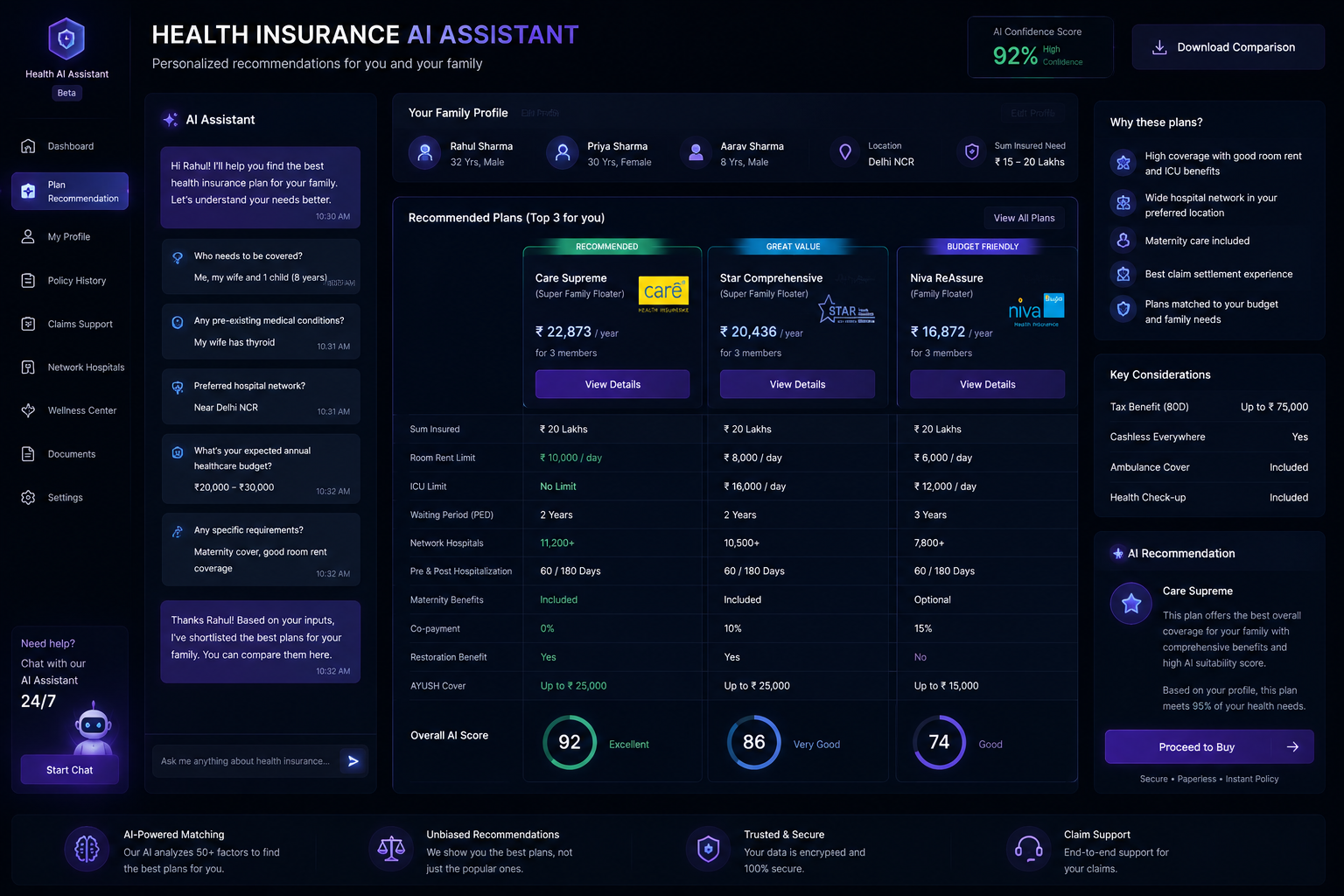
Health insurance is the sub-domain where customers are most confused at the point of purchase.
Sum insured, sub-limits, room-rent caps, waiting periods, co-payments, network hospitals, exclusions for specific procedures, restoration benefits: the product surface is genuinely difficult, and customers routinely buy the wrong cover, either too thin to be useful or too rich to be sustainable.
Conversational AI plays a role here that has nothing to do with pricing or claims and everything to do with helping the customer understand what they are buying.
A guided dialogue that elicits family composition, existing conditions, hospital preferences, geographic catchment, and budget can recommend a coverage band that is genuinely fit for purpose.
The technology is not new.
Recommendation engines for insurance products have existed for years.
But the language-model layer makes the conversation actually conversational rather than a sequence of dropdowns, and the multi-lingual reach matters as much here as it does anywhere.
The framing point is that AI, at this stage of the customer journey, can be more clearly pro-customer than pro-insurer.
A model optimised to recommend the cover that best matches the customer's circumstances, rather than the highest-margin cover the insurer sells, is a different model from one optimised for cross-sell.
The industry has not entirely settled which of those it will build.
The difference is not visible to the customer.
It is visible only in how the model is trained and what it is optimised for.
Regulatory attention to this question is increasing, and is likely to increase further.
Affordability assessment, drawing on consented alternative data, addresses the related problem of mis-selling.
A customer nudged into a premium they cannot sustain past year two is a customer whose policy will lapse, whose claim will not be paid because of waiting-period rules, and whose trust in the industry will be permanently damaged.
A reasonable affordability check at point of sale costs the insurer a small amount of premium volume in the short term and saves both parties significant pain in the medium term.
Cashless claims and health fraud detection
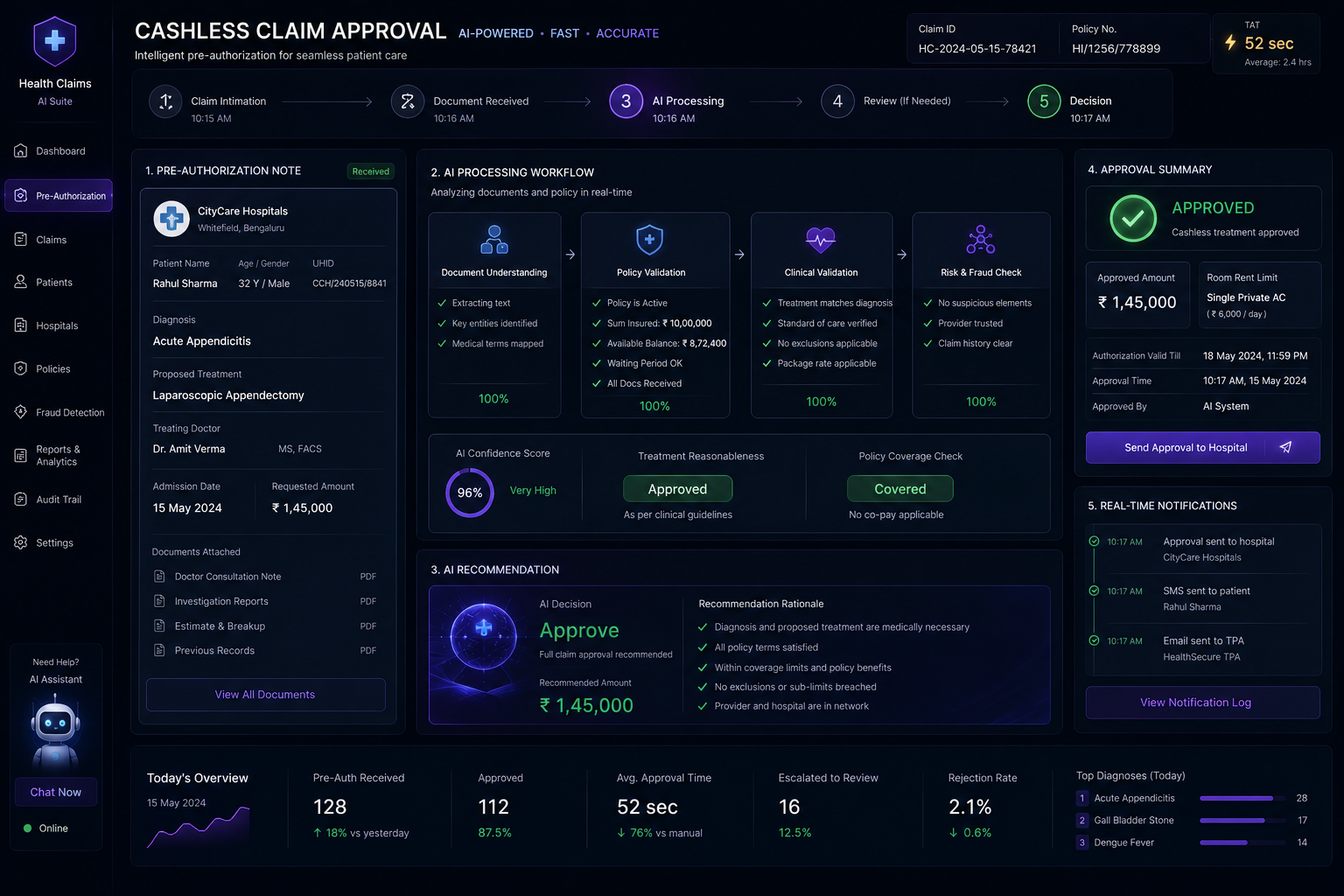
The largest deployed AI win in Indian health insurance is unglamorous and operational.
Cashless claim approval at hospital admission used to take hours.
The hospital sends a pre-authorisation note describing the patient's condition and the proposed treatment.
A claims executive at the insurer reads the note, looks up the policy terms, checks the network arrangement, and decides whether to approve.
For most cases, that pipeline now runs through a model.
The doctor's note is parsed, the policy terms are matched, the clinical reasonableness of the treatment is checked against benchmarks, and a decision is returned in seconds rather than hours.
The remaining cases such as unusual procedures, large sums, and ambiguous diagnoses are routed to humans.
The patient and the family wait less time at admission.
The insurer processes more claims with the same staff.
The hospital's billing team has fewer back-and-forth queries.
The other significant AI presence in health insurance is on the fraud side.
Procedure-billing patterns at specific hospitals, unusual frequencies, unusual combinations, and unusual sums are detectable as anomalies in ways that would not be obvious to a single claims executive.
The investigations remain human-led, but the targeting is increasingly data-led, and the ratio of investigators to claims has improved correspondingly.
Fire, property, and the long tail
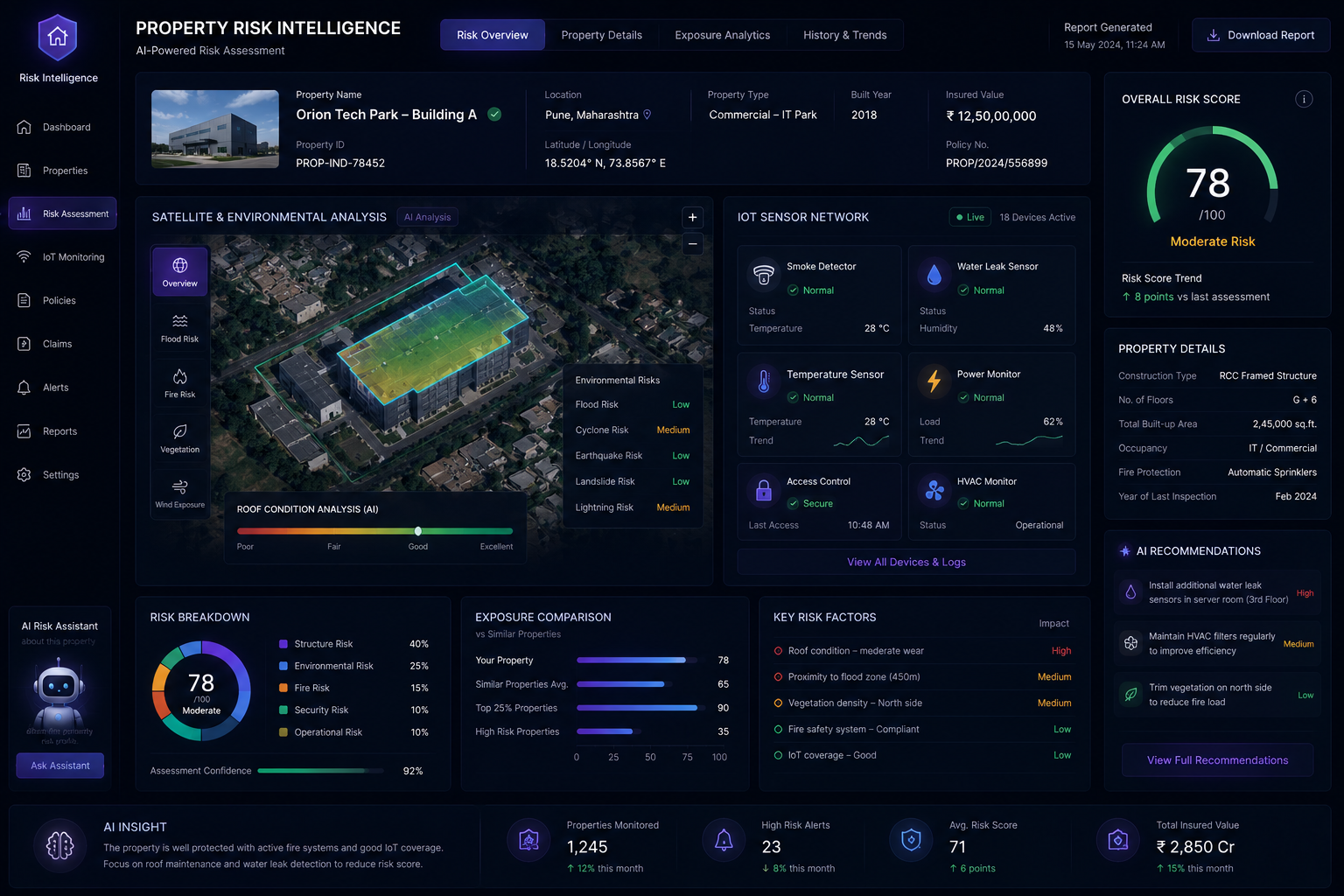
Fire and property insurance, along with the related categories of marine, agriculture, and commercial liability, share a structural feature: the insured asset is physical, geographically fixed or, in the case of marine, geographically tracked, and visible from above.
That makes them unusually well-suited to remote-sensing and IoT-driven approaches.
Risk assessment in property insurance has traditionally relied on declared information about the building's construction, occupancy, and fire-protection measures, verified, if at all, by an occasional surveyor visit.
Satellite imagery has compressed this pipeline.
Roof condition, vegetation encroachment, proximity to water bodies and flood plains, historical change over time, even the presence of fire-protection infrastructure visible from above: all of these can be assessed without sending anyone to the site.
Crop health for agricultural cover is estimated from satellite vegetation indices, with insurance pricing and pay-outs increasingly tied to remotely-observed conditions rather than to claims-based assessment.
For commercial property, IoT extends the same idea into a continuous signal.
Smoke detectors, water-leak sensors, temperature monitors, and entry-point sensors do not just trigger alarms.
They feed a continuous risk telemetry back to the insurer.
A building that demonstrates over a year that its monitoring is operational, its sensor history is clean, and its events are responded to promptly is, by any reasonable assessment, a lower-risk building than one that does not.
Premium structures that reflect this are emerging, particularly at the larger end of the commercial market.
Catastrophe claims and document automation
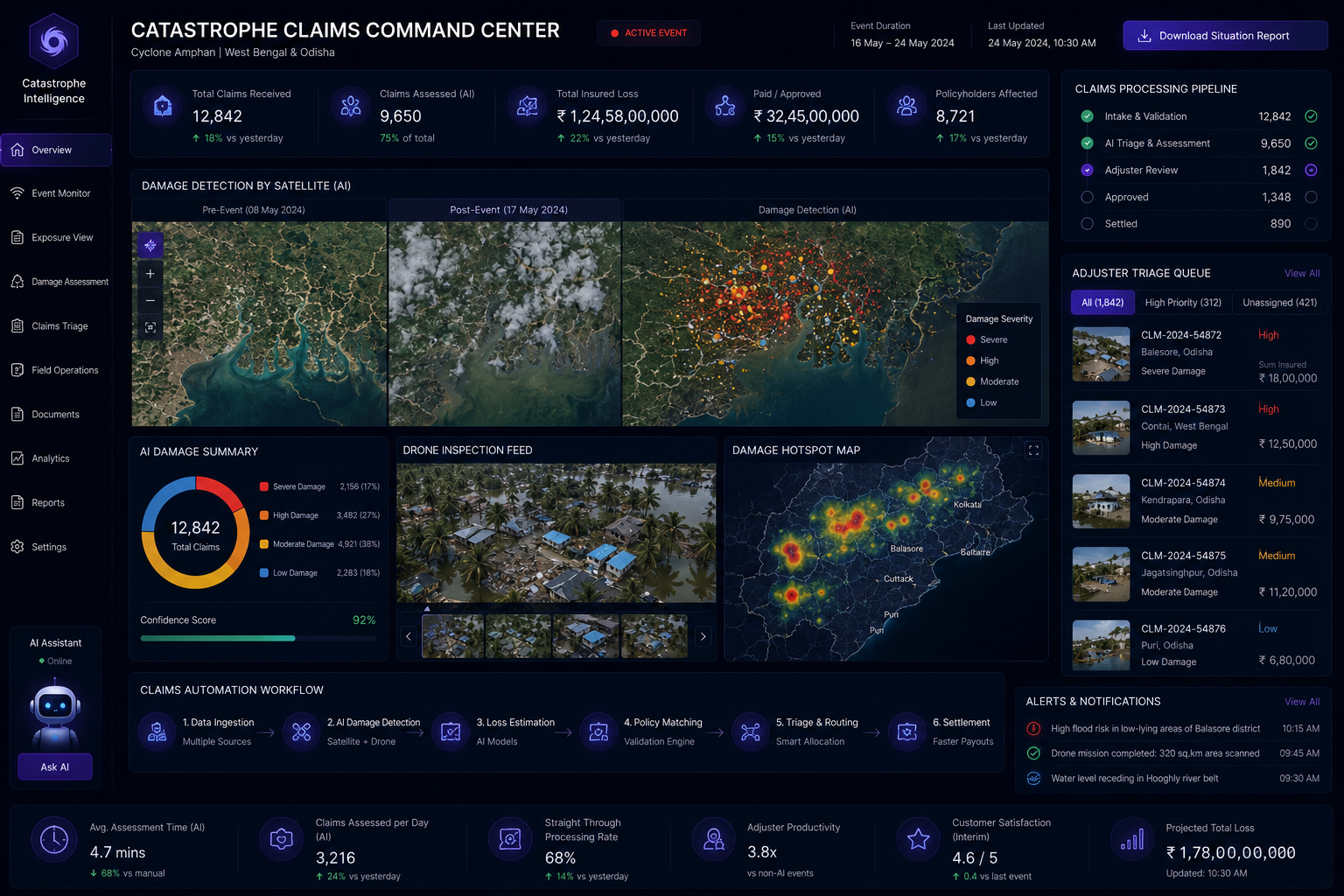
Catastrophe modelling, which covers low-frequency, high-severity events such as earthquakes, cyclones, and floods, is an area where machine-learning techniques have augmented rather than replaced the traditional engineering-based models.
The traditional models are physical: they simulate the event and its consequences from first principles.
The machine-learning layer typically refines exposure assessment, post-event damage estimation, and the spatial granularity at which losses are projected.
For Indian regions, where historical loss data is too thin to support purely actuarial catastrophe pricing, the combined approach is genuinely useful.
Claims processing in the wake of a catastrophe is the area where AI's effect is most operationally significant, and most under-discussed.
After a major cyclone or flood, an insurer faces thousands of claims arriving within days, and the binding constraint on response speed is not money but adjuster supply.
Drone-based imagery and satellite differencing, which compares post-event imagery to pre-event imagery to assess damage, allow an insurer to triage and assess in parallel rather than serially.
Claims for total losses can be processed before an adjuster physically arrives, with on-the-ground assessment reserved for ambiguous cases.
The document layer of fire and property claims such as invoices, FIRs, surveyor reports, fire-brigade assessments, and contractor estimates is the unglamorous twin of the imagery story.
Large-language-model-based document extraction, reconciled against policy terms, has cut the time taken to settle straightforward claims from weeks to days at most large general insurers.
The technology is not novel.
The deployment is.
Fraud detection across insurance networks
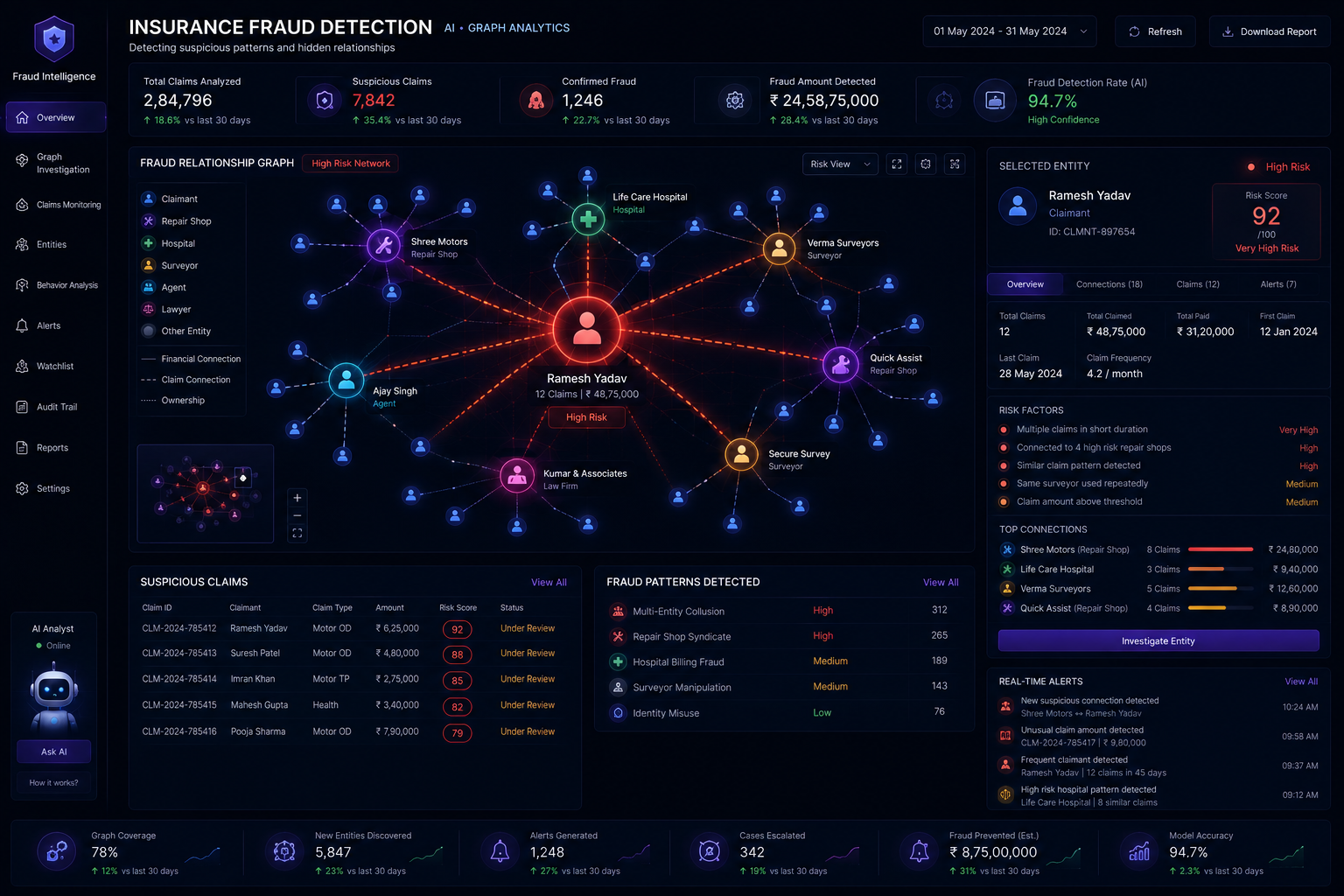
Fraud in insurance rarely appears as a single isolated claim.
It often appears as a pattern.
A repair shop appears too often.
A hospital bills an unusual combination of procedures.
A surveyor repeatedly appears in high-value claims.
A claimant is connected to more incidents than expected.
A set of policies, addresses, phone numbers, garages, doctors, or agents begins to form a suspicious network.
This is where graph analytics becomes powerful.
Instead of examining claims as isolated rows in a database, insurers can examine them as connected events.
AI models can surface clusters that humans would not notice manually.
The actual investigation still belongs to humans.
But the targeting becomes far more precise.
This is one of the clearest examples of AI helping insurers reduce leakage without slowing every honest claim.
Trust, regulation, and what is still hard
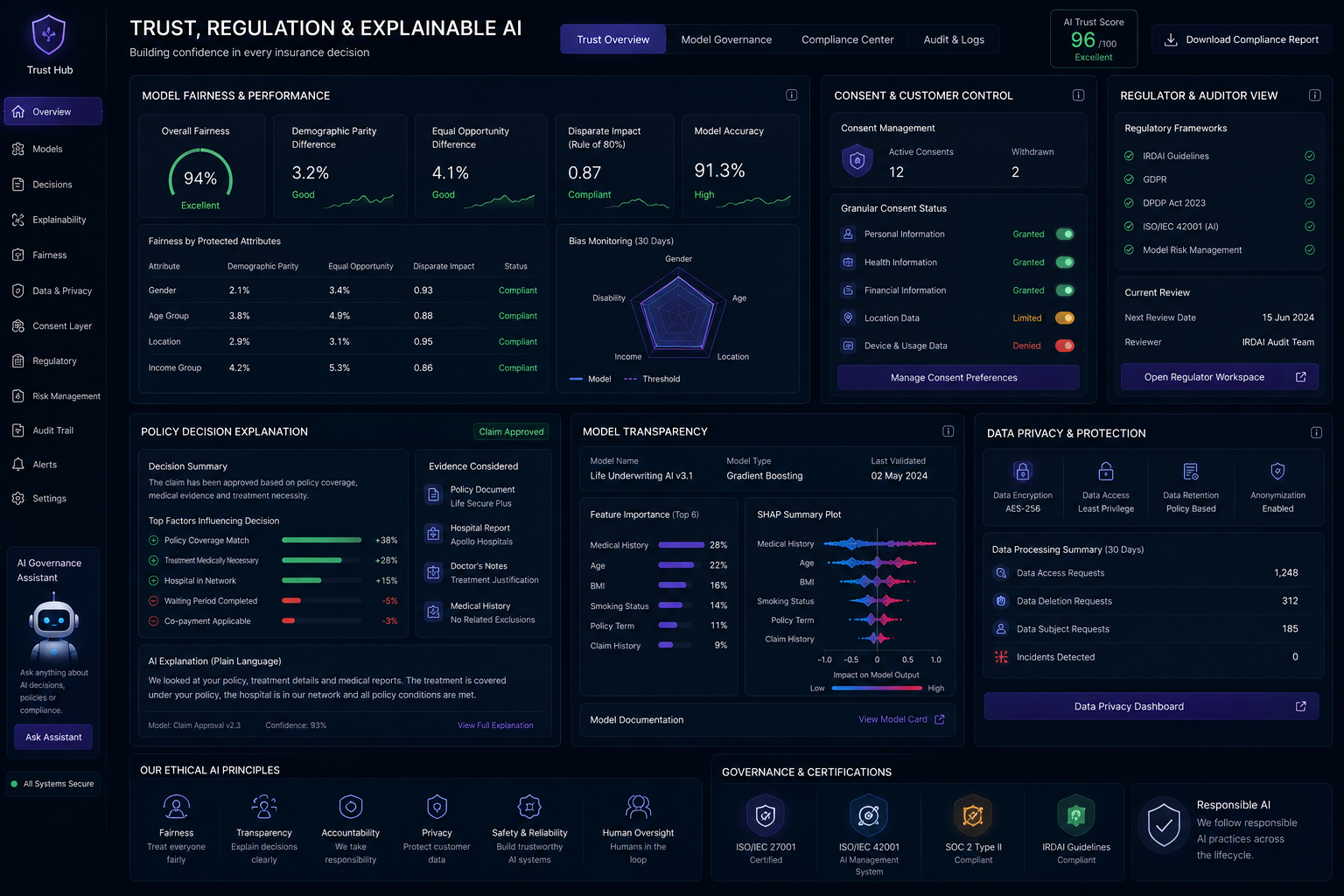
The picture so far is largely one of incremental, deployed, commercially-justified applications.
The harder questions are about the things AI in insurance does not yet do well, and about whether the directions of travel are ones the industry, and its regulators and customers, should be comfortable with.
Three of these questions are worth naming directly.
The first is bias.
An actuarial table that priced in broad demographic buckets was crude, but its crudeness was its honesty.
The categories were visible, the assumptions were inspectable, and the discrimination it produced was openly debated.
A model that prices individuals using hundreds of features can be fairer in aggregate and yet systematically disadvantage particular groups in ways that are harder to see and harder to challenge.
The Indian regulator, IRDAI, has begun engaging with the question, as have the European Union under its AI Act and a fragmented set of state-level insurance commissioners in the United States.
The regulatory landscape is unsettled, the technical methods for assessing model fairness are still maturing, and the gap between what is technically possible and what is being demanded is wide.
The second is explainability.
A customer who is denied a policy, charged a higher premium, or denied a claim is entitled to a reason.
"The model said so" is not a reason.
The technical literature on model explainability has grown substantially, but the gap between what a researcher can explain and what a customer or a regulator will accept as an explanation is real.
Most insurers are running production models well in advance of having a satisfactory account of why those models make the decisions they do.
The constraint that has held the worst applications back is, mostly, regulatory caution rather than technical sufficiency.
The third is data, consent, and the particular shape of these questions in India.
The Digital Personal Data Protection Act, the account-aggregator framework, IRDAI's evolving stance on alternative data, and the general direction of Indian data-protection policy are all converging on a model where the customer's consent is granular, revocable, and central to what the insurer can do.
This is, on balance, a good thing for the long-run health of the industry, even though it constrains some of the more aggressive applications of alternative data that have been deployed in less-regulated markets.
The opportunity in India is unusually large precisely because the data infrastructure is being built now, with privacy plumbing baked in from the start, rather than retrofitted onto decades of unconsented data as has been the case in older markets.
A practitioner observation worth recording: the insurance industry has long been more conservative about adopting new techniques than its peers in banking or capital markets.
The conservatism is not entirely unjustified.
The industry's products are long-dated, its customer base is unusually broad, its regulators are unusually cautious, and its mistakes are unusually visible.
A denied claim is a story, often a public one.
AI deployments that have succeeded inside the industry have tended to be the ones that picked their battles carefully, scoped their pilots conservatively, and treated regulatory engagement as a first-class part of the project rather than an afterthought.
Closing
Insurance has always been about pricing the unknown.
The math built the industry.
The paperwork ran it.
AI does not replace either, and the framing that sees it as doing so misreads what is actually happening on the ground inside insurers.
What AI does is extend the surface area of what the industry can see and respond to.
Doctors' notes that were skimmed are now read in full.
Damage to a vehicle that required a garage visit is now assessed from a phone.
Cashless claims that took hours are decided in seconds.
Catastrophe claims that overwhelmed adjuster supply are processed in parallel from drones.
Risks that were priced from population averages are increasingly priced from individual signal.
Customers who could only be served in two languages are now reached in a dozen.
None of these is, taken alone, transformational.
Taken together, they amount to an industry that costs less to run, reaches more customers, settles more claims more quickly, and prices risk more accurately than it did a decade ago.
They also amount to an industry that knows much more about its customers than it ever has before, and where the regulatory and ethical questions about what it should do with that knowledge are not yet settled.
The part that is not AI, meaning earning, holding, and not abusing the customer's trust to use this much information about them, is what will ultimately decide which insurers win the next decade.
The technology is, to a first approximation, available to everyone.
The discipline to deploy it well, regulate it carefully, and explain it honestly is not.