
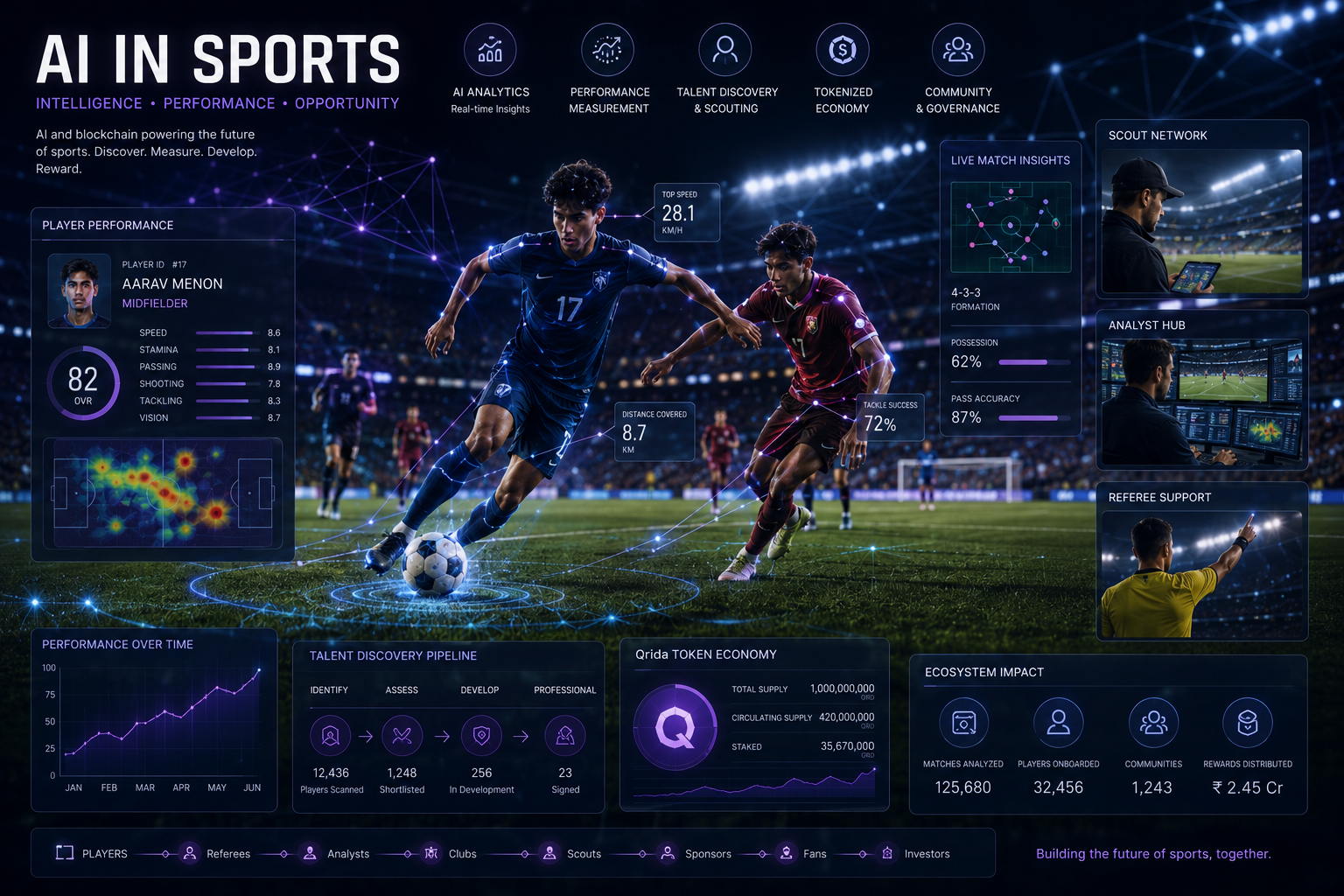
Why AI in Sports Matters
I spent a large part of my college years around football grounds.
Not as a spectator.
As a player.
And once you spend enough time inside sports ecosystems, especially at the grassroots level in India, you start noticing something very quickly.
Talent is everywhere.
Structure is not.
There are thousands of incredibly talented players competing every single week across schools, colleges, local tournaments, and small football communities.
But most of them disappear.
Not because they are not good enough.
Because the system around them is incomplete.
There are not enough scouts.
Not enough analysts.
Not enough structured performance measurement.
Not enough financial incentives.
Not enough visibility.
And most importantly, not enough mechanisms to consistently value player performance.
This is where AI becomes important.
Most people think AI in sports is only about analytics dashboards inside professional clubs.
That is only a tiny part of the picture.
The real opportunity is much bigger.
AI allows sports ecosystems to finally become measurable at scale.
Once performance becomes measurable, it becomes valuable.
And once value becomes measurable, markets can form around it.
That changes everything.
The Core Problem in Sports
Sports economies are fundamentally driven by one raw commodity:
Human performance.
Every part of the sports ecosystem depends on players competing against each other.
Without competitive activity:
- there are no clubs
- no referees
- no analysts
- no broadcasters
- no scouts
- no advertisers
- no fan communities
- no sports economy
But there is a problem.
The current structure of grassroots sports in India makes it extremely difficult for players and professionals to continuously monetize their participation.
Most tournaments are temporary.
Most player performance data disappears after the final whistle.
Most matches are never properly analyzed.
Most players never build measurable performance histories.
This creates a broken feedback loop.
A player may dominate local tournaments for years and still remain invisible outside a small community.
A referee may officiate hundreds of matches with no structured reputation layer.
An analyst may produce valuable tactical insights with no scalable distribution mechanism.
The market cannot properly value what it cannot properly measure.
That is where AI changes the structure itself.
AI as the Measurement Layer of Sports
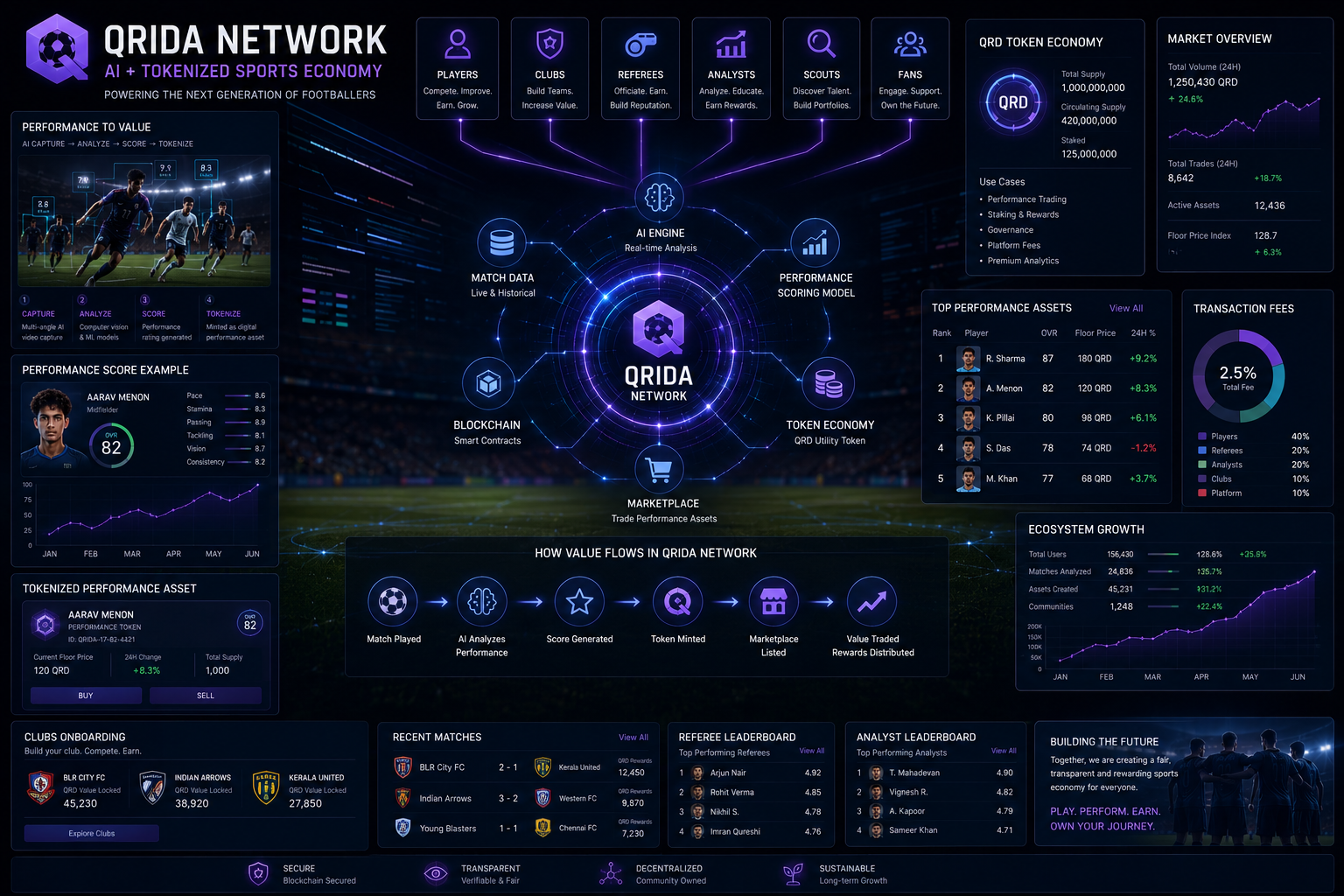
Artificial intelligence introduces a scalable intelligence layer across sports ecosystems.
Computer vision systems can now:
- track player movement
- analyze positioning
- detect passing patterns
- measure stamina
- monitor acceleration
- identify tactical structures
- generate heatmaps
- evaluate match intensity
- produce highlights automatically
This dramatically reduces the cost of sports intelligence.
Historically, detailed performance analysis was available only for elite clubs because analysts, cameras, infrastructure, and processing were expensive.
AI changes that equation.
A college football match recorded on a phone can now generate structured performance insights.
This matters because performance data becomes the foundation for everything else.
Once performance is measurable consistently:
- players can build portable reputations
- analysts can improve scouting quality
- clubs can discover hidden talent
- referees can improve officiating quality
- tournaments become more structured
- communities gain visibility
- sponsors gain measurable exposure
AI turns fragmented sports participation into structured economic activity.
Qrida: AI + Tokenomics for the Next Generation of Footballers
One of the ideas we strongly believe in is that sports ecosystems require both intelligence infrastructure and economic infrastructure.
AI solves the intelligence layer.
Tokenomics can solve the participation and value distribution layer.
This is the core direction behind Qrida.
Qrida is fundamentally an attempt to rethink how value is created and distributed across sports ecosystems.
Today, most value in sports is concentrated at the top:
- elite leagues
- broadcasting rights
- sponsorships
- advertising
- celebrity athletes
But the foundational layer of sports is still grassroots competition.
That is where future talent is produced.
That is where physical participation happens.
That is where long-term sports culture develops.
The problem is that grassroots participation has almost no scalable financial structure around it.
Qrida attempts to change this by combining:
- AI-powered performance measurement
- blockchain infrastructure
- tokenized incentives
- competitive participation systems
- reputation and skill tracking
- sports financial coordination
The idea is not speculation for the sake of speculation.
The idea is building market structures around measurable physical performance.
Imagine a football ecosystem where:
- players earn reputation and incentives based on verified match activity
- referees build transparent officiating records
- analysts contribute tactical intelligence
- clubs build measurable competitive histories
- communities organize around performance data
- markets coordinate around objective activity
This creates a very different sports economy.
One where participation itself becomes economically visible.
Why Football Is the Starting Point
Football is uniquely suited for this kind of experimentation.
The sport naturally creates:
- continuous movement
- measurable spatial positioning
- repeatable tactical structures
- high-frequency competition
- scalable grassroots participation
Most importantly, football communities already exist organically across colleges and local tournaments.
The problem is not lack of participation.
The problem is lack of infrastructure around participation.
AI allows that infrastructure to scale without requiring elite-level budgets.
A simple recording setup combined with AI systems can now generate insights that previously required full analyst teams.
This lowers the barrier for intelligence creation across the sports economy.
How Qrida Can Extend Into Cricket
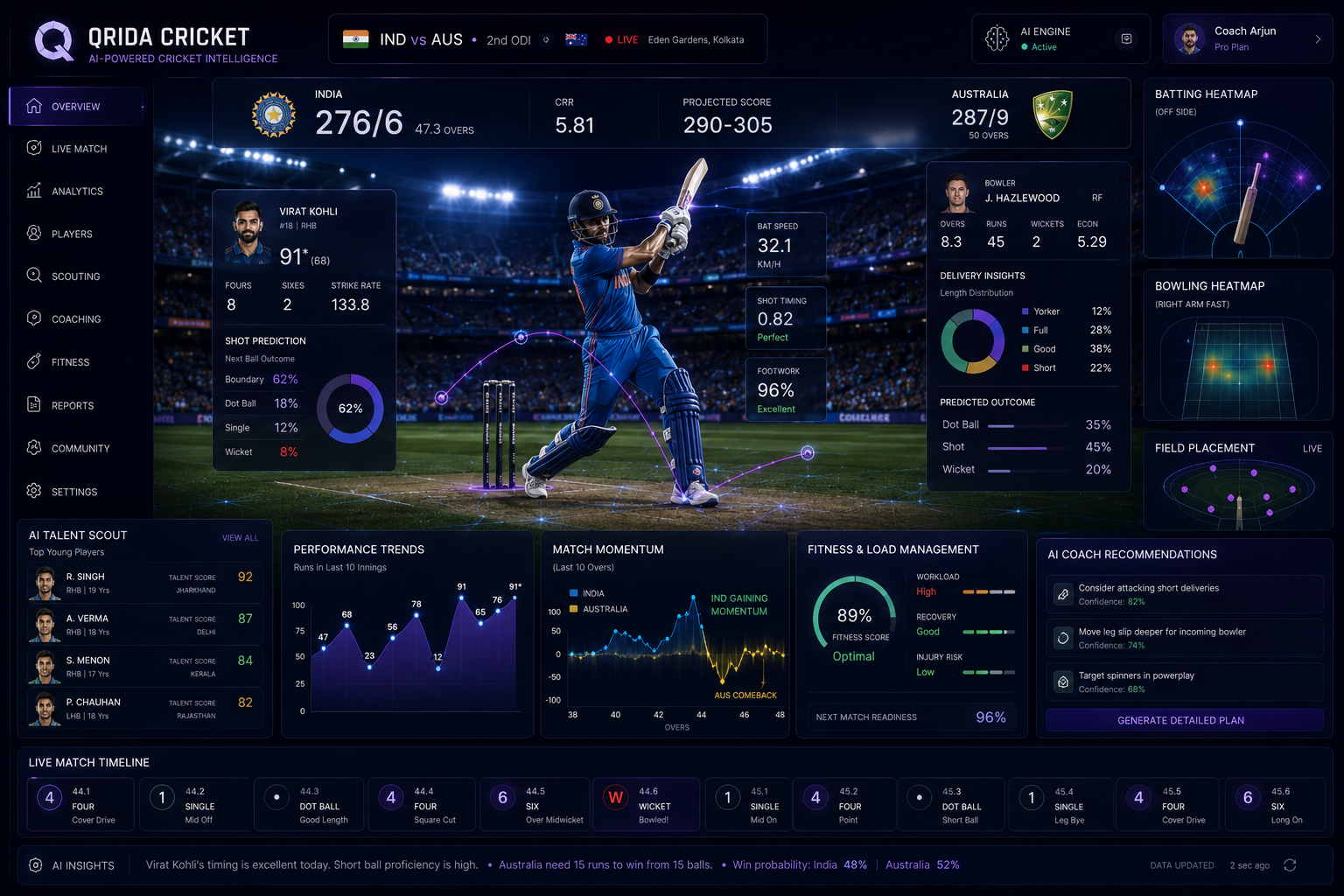
Cricket introduces an even larger opportunity.
India already has one of the largest cricket ecosystems in the world.
But grassroots visibility remains fragmented outside structured professional pathways.
AI can fundamentally reshape cricket infrastructure across several layers.
Talent Discovery
AI systems can analyze:
- bowling actions
- batting timing
- shot placement
- footwork efficiency
- reaction speed
- field positioning
- consistency patterns
This allows hidden talent to surface earlier.
A player performing exceptionally in district-level matches can become measurable beyond local visibility.
Performance Intelligence
Cricket already generates enormous statistical data.
AI allows this to become contextual.
Instead of only tracking:
- runs
- wickets
- strike rate
AI can analyze:
- pressure handling
- shot selection quality
- fatigue patterns
- tactical adaptability
- bowling variations
- field awareness
This creates much richer performance evaluation systems.
Injury Prevention
Fast bowlers especially face long-term injury risks.
AI combined with motion analysis and wearable systems can help identify:
- workload imbalance
- biomechanical stress
- fatigue accumulation
- dangerous movement patterns
This is important because many young athletes in India lack access to advanced sports science infrastructure.
AI can democratize parts of that intelligence.
Grassroots Cricket Networks
India’s local cricket ecosystem is enormous but highly fragmented.
AI systems can create standardized performance visibility across:
- school cricket
- district leagues
- local tournaments
- academy systems
- college competitions
This creates more transparent pathways for talent progression.
AI Beyond Football and Cricket
AI in sports is not limited to team sports.
The larger shift is that sports itself is becoming increasingly measurable.
This affects almost every sport.
Basketball
AI systems can analyze:
- player spacing
- shot probability
- defensive efficiency
- fatigue patterns
- passing networks
Real-time tactical intelligence becomes accessible even outside professional leagues.
Athletics
Sprint analysis, gait tracking, jump mechanics, endurance optimization, and injury prediction become measurable through AI-assisted biomechanics.
This is particularly valuable in countries where elite coaching access remains limited.
Combat Sports
Computer vision systems can analyze:
- reaction timing
- strike efficiency
- defensive movement
- stamina decline
- training intensity
This allows more scientific performance development.
Esports
AI systems already heavily influence esports through:
- strategic analysis
- player behaviour modeling
- automated replay intelligence
- audience analytics
- performance optimization
Esports demonstrates how deeply data-native sports ecosystems can become.
AI, Sports, and Economic Coordination
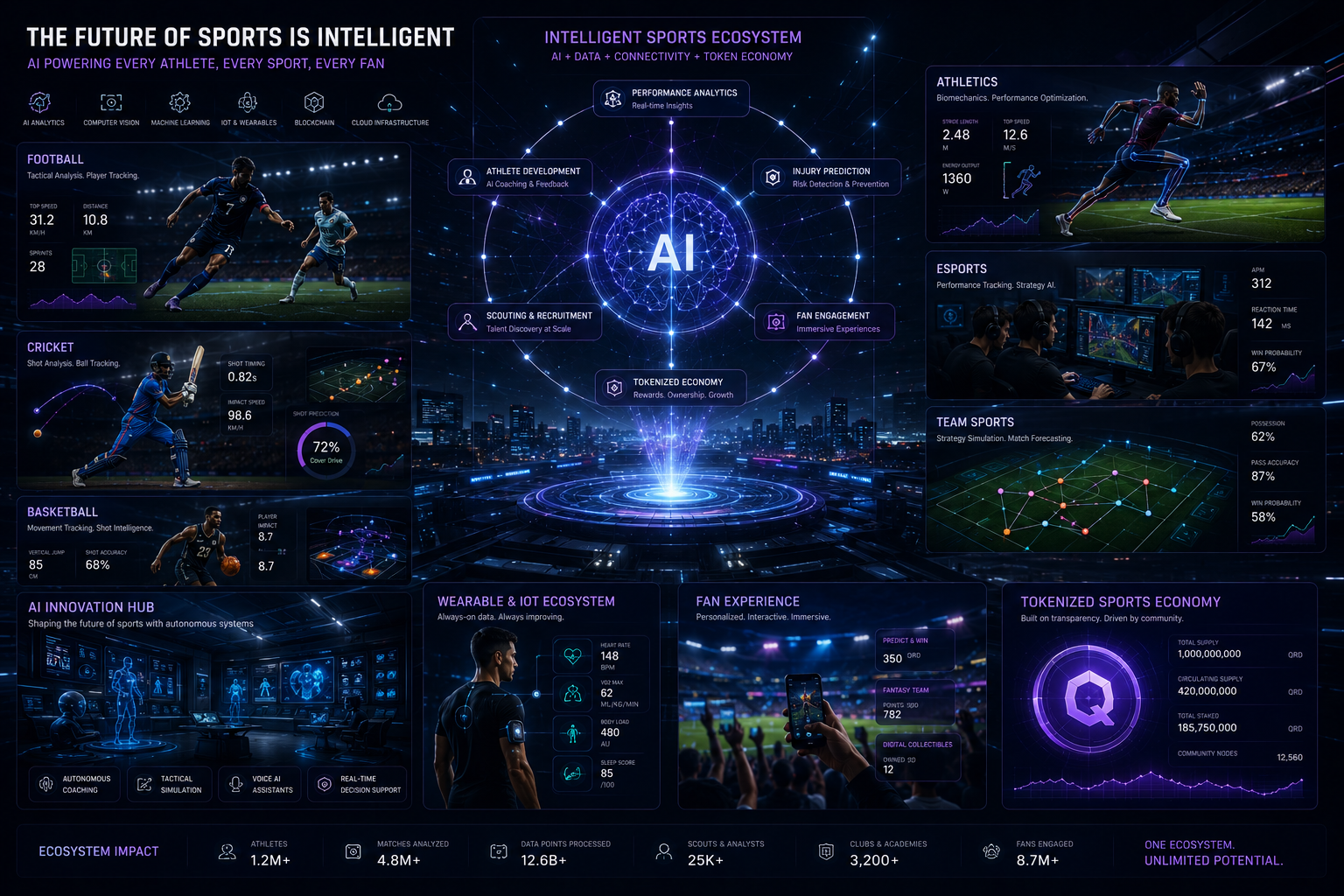
One of the most interesting long-term implications of AI in sports is economic coordination.
Sports markets historically concentrated value at the entertainment layer.
AI may allow value creation to expand downward into participation layers.
When performance becomes measurable:
- markets can coordinate around it
- communities can organize around it
- incentives can distribute around it
- infrastructure can scale around it
This is why AI in sports matters beyond analytics.
It changes how sports ecosystems organize themselves economically.
The long-term opportunity is not simply better dashboards.
The opportunity is creating systems where:
- players
- analysts
- referees
- clubs
- coaches
- communities
- fans
can all participate inside measurable sports economies.
Final Thoughts
Sports has always created value.
The problem is that most of this value was difficult to measure, distribute, and coordinate at scale.
Artificial intelligence changes that.
It allows physical performance itself to become structured data.
And once physical performance becomes structured data, entirely new economic systems can emerge around it.
That is why AI in sports matters.
Not because it replaces human competition.
But because it gives human competition a scalable intelligence and economic infrastructure layer for the first time.
At Asgorithm Technologies, we believe AI in sports is still at the very beginning.
The next decade will likely see sports evolve from isolated competition ecosystems into interconnected intelligence networks powered by:
- AI
- computer vision
- wearable systems
- blockchain infrastructure
- performance analytics
- tokenized participation systems
And somewhere inside that future, the next generation of athletes may finally have systems capable of valuing their performance long before the world notices their name.