
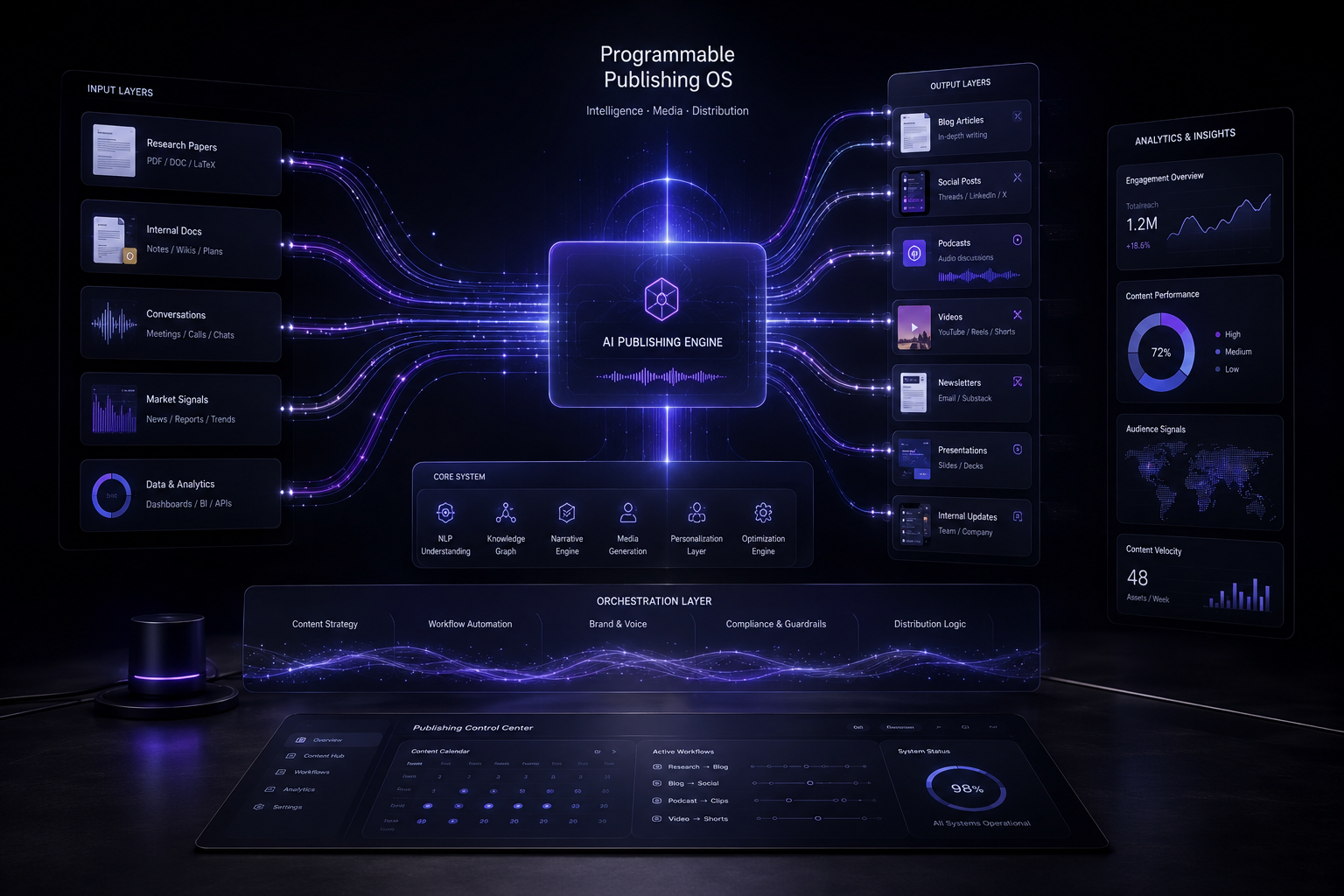
The internet was originally built around static publishing. A person writes content, uploads it to a server, and distributes it through websites or links. Over time, this evolved into algorithmic feeds, recommendation engines, creator platforms, and social media ecosystems. Today, another transition is happening quietly underneath the surface of the modern web.
Publishing itself is becoming programmable.
Artificial intelligence is transforming content systems from isolated workflows into adaptive computational infrastructures capable of generating, restructuring, translating, distributing, and continuously optimizing information across multiple formats and platforms.
This is no longer about simply generating blogs faster.
It is about building systems where research, communication, design, media generation, semantic memory, analytics, and audience adaptation operate as interconnected layers inside a programmable publishing stack.
The next generation of organizations will not think of content as marketing alone.
They will think of it as infrastructure.
The Evolution of Publishing Infrastructure
Traditional publishing systems are linear.
A founder writes a post.
A designer creates visuals.
A marketer schedules distribution.
A video editor creates clips.
A researcher prepares supporting documents.
A community manager adapts the same information for social platforms.
Each stage operates independently with separate tools, people, and workflows.
AI collapses many of these boundaries.
A single research document can now become:
- Technical blogs
- Founder threads
- Podcast scripts
- AI-generated narration
- Short-form videos
- Presentation decks
- Investor updates
- Product explainers
- Community content
- Interactive tutorials
- Internal knowledge systems
This changes the role of publishing from manual production into orchestration.
The important shift is not that AI can generate content.
The important shift is that organizational context becomes reusable computationally.
Once information enters the system, it can continuously transform into multiple communication layers.
The Programmable Publishing Stack
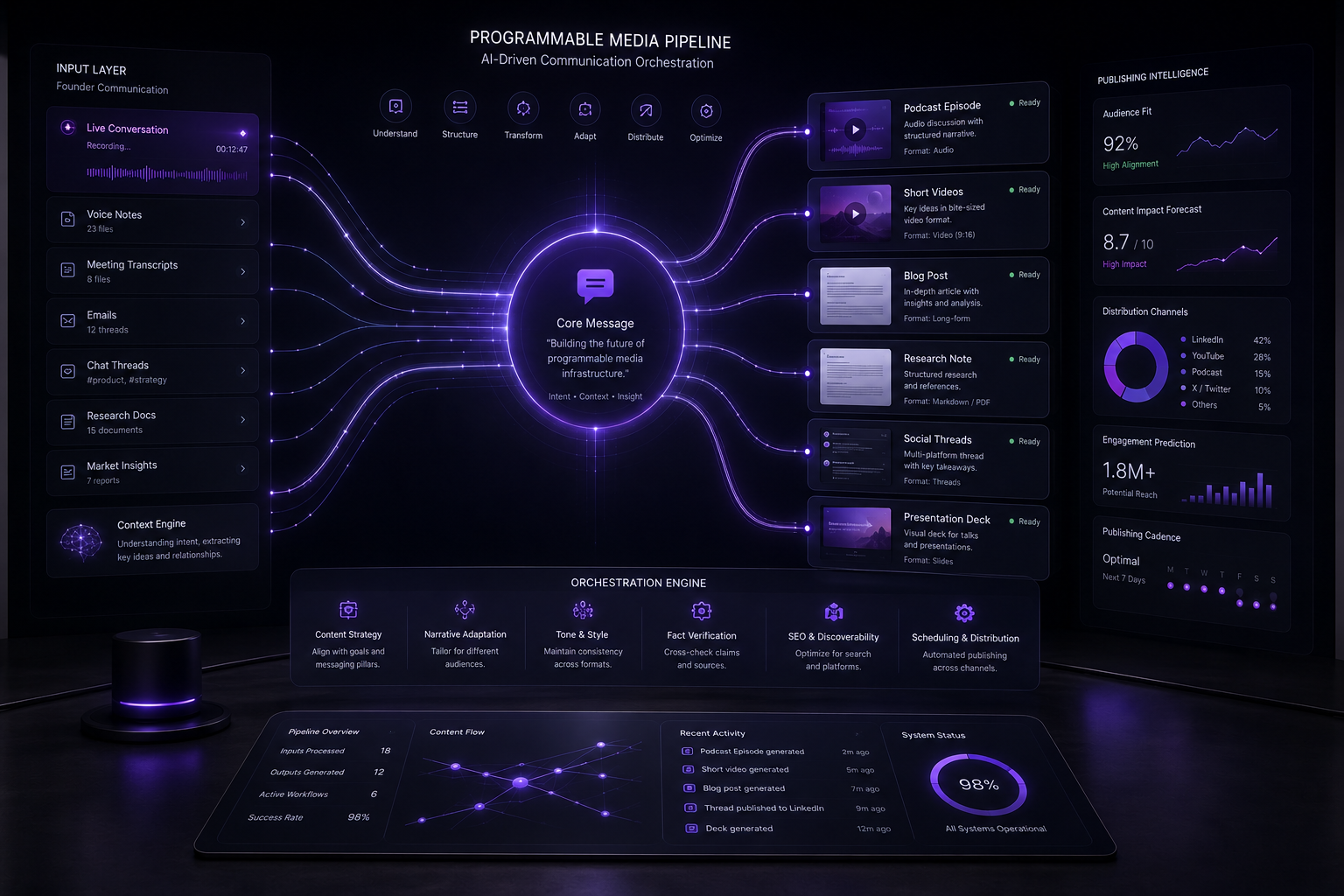
Modern publishing systems increasingly resemble software systems.
Instead of manually creating every communication asset independently, organizations are beginning to build adaptive pipelines where content flows through multiple AI-assisted stages.
Research Layer
The research layer acts as the entry point of organizational intelligence.
Knowledge may originate from:
- Internal documents
- Product discussions
- Research papers
- Meeting transcripts
- Community conversations
- Customer support interactions
- Analytics dashboards
- Market intelligence
- API-generated datasets
Large language models can summarize, cluster, structure, and semantically connect these information sources into reusable contextual memory.
This creates something much more powerful than documentation.
It creates an organizational knowledge graph.
Instead of isolated files scattered across Notion, Slack, and Google Docs, the system begins understanding relationships between concepts, discussions, products, and narratives.
Narrative Layer
Once research becomes structured semantically, AI systems can dynamically adapt the same information for different audiences.
The same technical concept may be rewritten for:
- developers
- investors
- beginners
- enterprise clients
- social audiences
- researchers
- media teams
This is becoming increasingly important because modern communication is inherently multi-contextual.
The same idea cannot be communicated identically across every platform.
A technical founder post on X differs significantly from a research paper or a product explainer video.
AI systems increasingly act as narrative translators between contexts.
Media Generation Layer
The media layer is evolving rapidly due to generative models.
AI systems can now generate:
- visual assets
- motion graphics
- AI voiceovers
- AI avatars
- cinematic explainers
- adaptive subtitles
- infographics
- presentation visuals
- synthetic B-roll
- interactive educational interfaces
This significantly changes the economics of media production.
Small teams can now operate with publishing velocity previously requiring large agencies or internal media departments.
The bottleneck shifts from production capability toward:
- creative direction
- system orchestration
- editorial coherence
- identity consistency
Distribution Layer
Distribution itself is becoming intelligent.
AI-assisted systems increasingly optimize:
- publishing timing
- SEO structure
- audience adaptation
- thumbnail testing
- retention analysis
- platform-specific formatting
- engagement clustering
- recommendation optimization
Future publishing systems may dynamically alter content itself depending on user behavior.
A beginner may receive simplified explanations and visual analogies.
A technical reader may receive diagrams and mathematical depth.
An investor may receive metrics and strategic framing.
The content itself becomes adaptive.
Founders as Media Systems
One of the biggest transformations introduced by AI publishing infrastructure is the rise of founders as programmable media entities.
Historically, founders communicated periodically through:
- interviews
- conferences
- launch announcements
- blogs
- investor reports
Today, founders are expected to maintain continuous communication loops across multiple platforms simultaneously.
This creates enormous operational pressure.
AI-assisted content systems reduce this friction dramatically.
A single founder conversation can now become:
- threads
- reels
- podcasts
- educational posts
- investor summaries
- product explainers
- internal updates
- semantic archives
The founder effectively becomes a continuously operating communication engine.
However, this creates a new challenge.
When content becomes infinitely generatable, authenticity becomes increasingly valuable.
The future advantage will not belong to organizations generating the most content.
It will belong to organizations capable of maintaining:
- coherence
- trust
- clarity
- technical depth
- identity consistency
while operating at machine-assisted scale.
Content as Organizational Memory
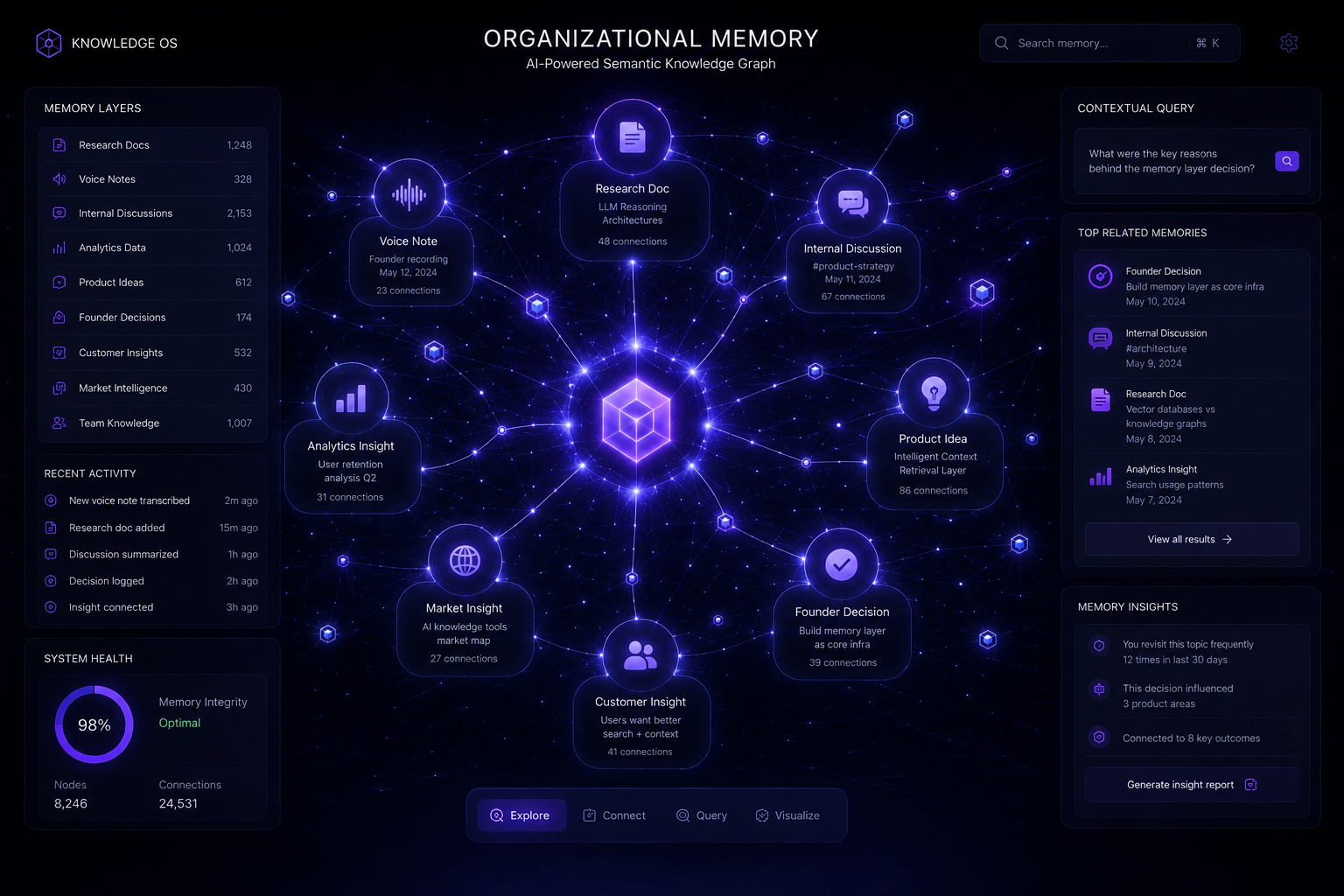
One of the most overlooked aspects of AI publishing systems is memory.
Most organizations lose enormous amounts of knowledge continuously.
Ideas remain fragmented across:
- Slack discussions
- voice notes
- internal docs
- meeting recordings
- temporary chats
- unfinished drafts
AI systems enable organizations to transform communication into persistent semantic memory.
This changes publishing from temporary output into long-term organizational intelligence.
Future publishing infrastructures may continuously index:
- founder opinions
- customer concerns
- research findings
- product decisions
- market reactions
- community feedback
- internal strategy discussions
This allows organizations to maintain continuity across years of communication evolution.
Publishing becomes less about broadcasting and more about preserving organizational cognition.
The Problem with Infinite Content
AI-generated publishing also introduces significant risks.
Content Inflation
When content generation becomes nearly free, information density collapses.
Audiences increasingly encounter:
- repetitive insights
- generic summaries
- shallow educational content
- synthetic engagement loops
- low-context explainers
As generation costs approach zero, attention becomes the primary scarcity.
Narrative Instability
Organizations generating large volumes of AI-assisted content may gradually lose coherence in tone, positioning, and technical accuracy.
Without strong editorial systems, publishing pipelines become fragmented.
The result is communication without identity.
Epistemic Degradation
Many AI systems generate plausible explanations without deep verification.
As synthetic publishing scales, distinguishing between:
- original research
- derived summaries
- hallucinated interpretation
- AI recombination
becomes increasingly difficult.
This creates growing importance for:
- attribution systems
- provenance infrastructure
- source validation
- reputation-aware publishing layers
Toward Autonomous Publishing Infrastructure
The long-term direction of AI publishing systems is autonomy.
Future systems may:
- monitor markets continuously
- detect communication gaps
- generate educational sequences
- adapt content dynamically
- optimize audience retention
- personalize information delivery
- maintain semantic memory
- orchestrate multi-platform communication
Publishing gradually transforms from a creative workflow into computational infrastructure.
However, human judgment remains central.
AI can optimize generation.
It cannot fully replace:
- taste
- emotional intelligence
- strategic timing
- ethical judgment
- cultural understanding
- long-term narrative coherence
The organizations that succeed will likely combine:
- human direction
- machine scalability
- semantic memory
- adaptive communication systems
into unified publishing architectures.
Conclusion
The future of publishing is not simply AI-generated content.
It is programmable communication infrastructure.
Research, media, founder communication, semantic memory, video generation, and adaptive distribution are converging into unified computational publishing systems.
Organizations that understand this transition early will operate fundamentally differently from traditional media structures.
They will not treat content as isolated marketing assets.
They will treat communication itself as an adaptive operating system capable of continuously translating organizational intelligence into multiple forms of expression.