
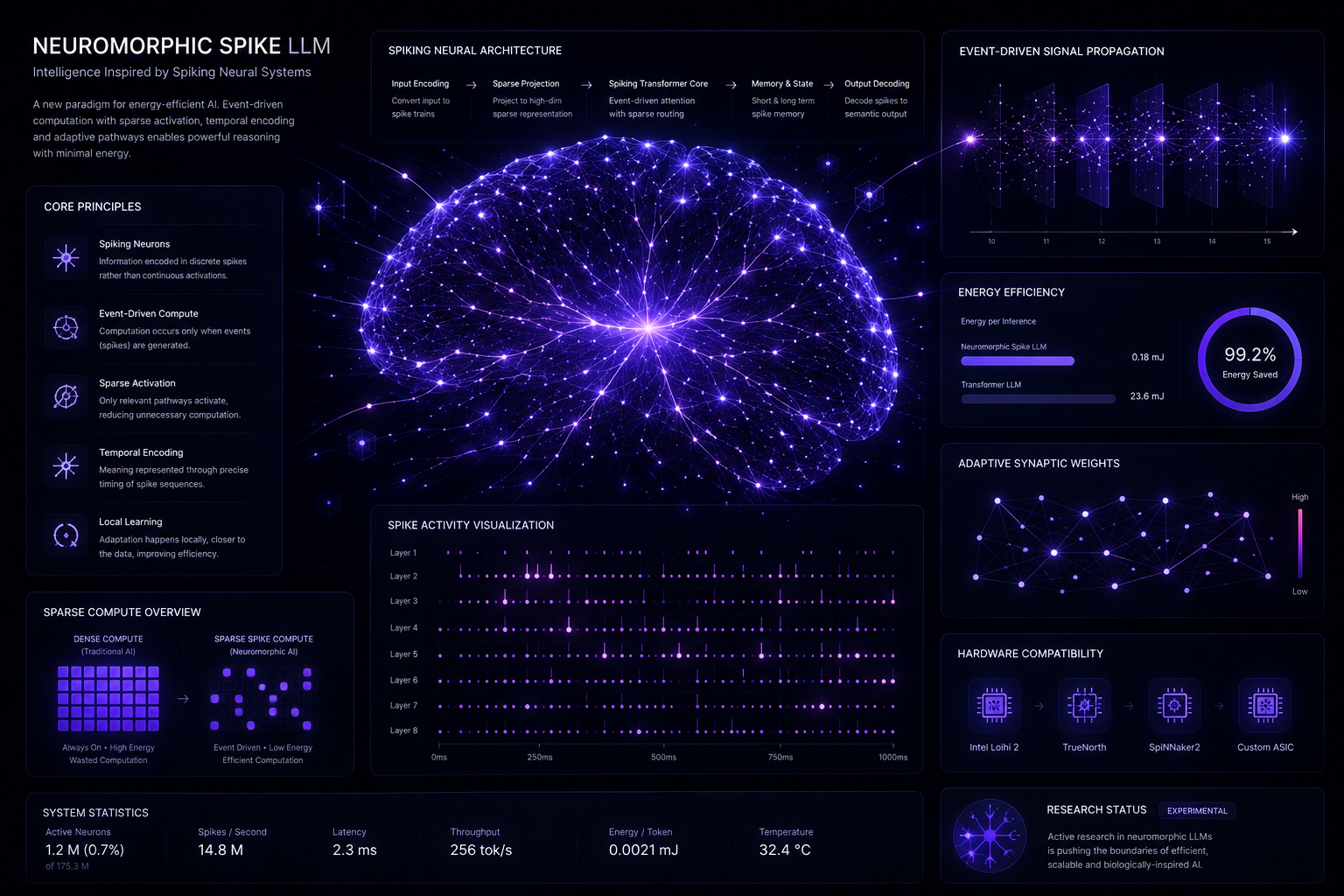
Modern artificial intelligence systems are extraordinarily powerful.
They are also extraordinarily expensive.
Large language models require massive computational infrastructure involving:
- GPU clusters
- high-bandwidth memory
- distributed networking
- continuous energy consumption
- large-scale inference infrastructure
As model capabilities scale, the energy requirements grow rapidly.
This has created increasing interest in alternative computational paradigms capable of delivering intelligence more efficiently.
One speculative direction attracting attention involves combining ideas from:
- neuromorphic computing
- spiking neural systems
- event-driven computation
- biologically inspired architectures
- large language model reasoning
The result is an emerging conceptual space sometimes described as spike-based or neuromorphic LLM systems.
These systems remain highly experimental.
However, they may represent important long-term directions for energy-aware intelligence.
Why Current AI Systems Consume So Much Energy
Traditional transformer-based models rely heavily on dense matrix multiplication.
During inference, large volumes of computation occur continuously regardless of whether all neurons or representations are equally important at a given moment.
This creates several inefficiencies.
Dense Activation Patterns
Most transformer systems process information through large fully active layers.
Even if only small portions of information are semantically important, substantial compute resources remain active.
Continuous Clocked Computation
Modern GPUs operate through highly synchronized parallel processing.
This differs significantly from biological brains, which operate asynchronously and event-driven.
Memory Transfer Bottlenecks
Large AI systems spend enormous energy moving data between:
- memory
- compute units
- caches
- accelerators
In many cases, data movement consumes more energy than computation itself.
These limitations become increasingly problematic as organizations attempt to deploy AI:
- on edge devices
- in robotics
- in embedded systems
- in autonomous agents
- across persistent inference environments
Energy efficiency becomes critical.
The Neuromorphic Idea
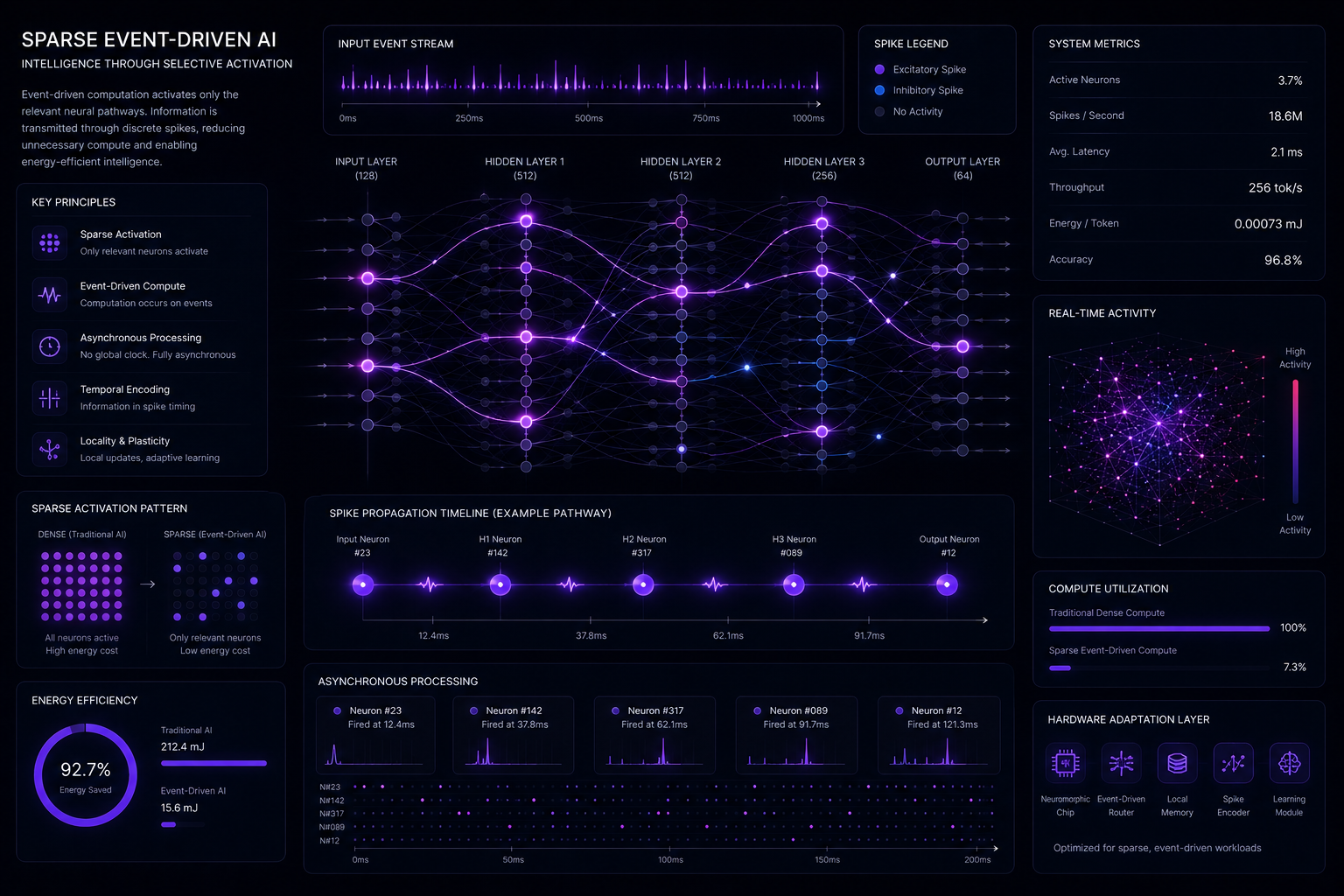
Neuromorphic computing attempts to design hardware and software inspired by certain properties of biological nervous systems.
Instead of continuously active computation, neuromorphic systems often rely on:
- sparse activation
- asynchronous signaling
- event-driven processing
- local memory coupling
- adaptive firing patterns
One important concept is the spiking neuron.
Traditional artificial neural networks communicate using continuous numerical activations.
Spiking neural networks instead communicate through discrete events called spikes.
Computation occurs primarily when meaningful activation events happen.
This can theoretically reduce unnecessary energy expenditure.
What Are Spike-Based Language Systems?
Spike-based language systems are still largely experimental.
The general idea involves integrating language modeling capabilities with sparse event-driven computational architectures.
Instead of every component remaining continuously active, only relevant regions may activate dynamically depending on context.
This creates several speculative advantages.
Sparse Compute Activation
Rather than activating massive portions of a network simultaneously, spike-driven architectures may selectively activate computational pathways.
This could significantly reduce energy usage.
Temporal Information Processing
Spiking systems naturally encode timing information.
This may allow richer representations of:
- sequential reasoning
- temporal dependencies
- sensory streams
- multimodal interaction
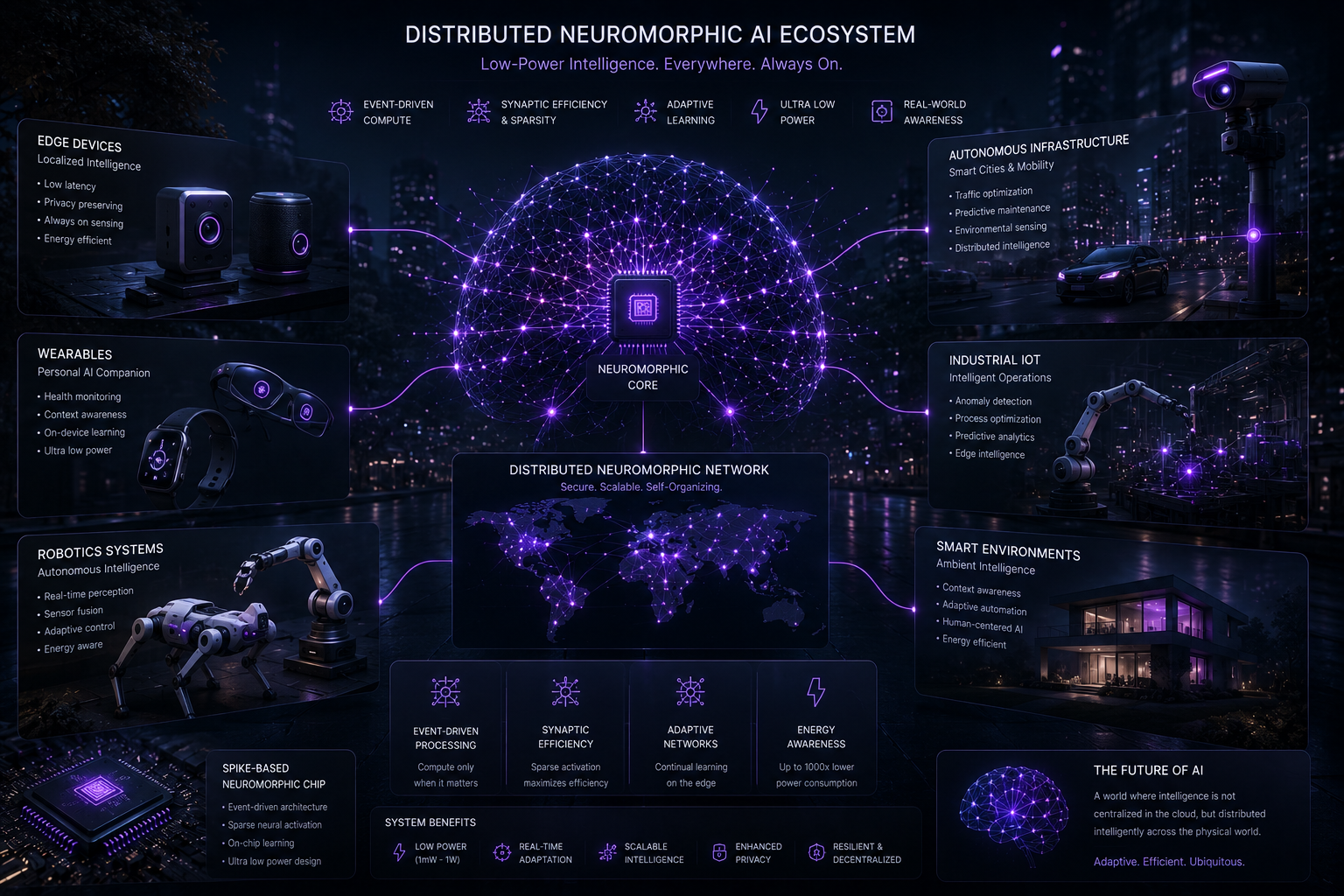
Edge Intelligence
Energy-efficient architectures may enable more advanced AI systems on:
- robotics platforms
- wearables
- mobile devices
- autonomous drones
- IoT infrastructure
without requiring constant cloud inference.
Persistent Autonomous Systems
Future AI agents operating continuously for long durations require efficient inference.
Neuromorphic systems may eventually support:
- always-on reasoning
- adaptive environmental awareness
- low-power contextual memory
- continuous multimodal processing
Biological Inspiration Versus Biological Accuracy
An important clarification is necessary.
Neuromorphic AI does not attempt to perfectly replicate the human brain.
The brain remains vastly more complex than current computational models.
Instead, researchers often borrow selective principles such as:
- sparsity
- local adaptation
- asynchronous signaling
- event-driven communication
- energy-efficient computation
The objective is engineering inspiration rather than biological simulation.
The Challenge of Combining Transformers and Spikes
Modern large language models are built around transformer architectures.
Transformers excel because they:
- parallelize efficiently
- scale effectively
- model long-range dependencies
- train predictably on large datasets
Spiking systems operate differently.
Integrating these paradigms creates difficult research problems.
Training Complexity
Backpropagation in spiking systems is significantly harder because spike events are often non-differentiable.
Researchers explore approximation techniques, surrogate gradients, and hybrid learning approaches.
Hardware Constraints
Most AI infrastructure today is optimized for dense tensor computation.
Neuromorphic systems may require specialized hardware architectures.
Examples include:
- Intel Loihi
- IBM TrueNorth
- experimental analog computing systems
- event-driven accelerators
However, widespread ecosystem support remains limited.
Scaling Challenges
Transformer models currently scale through massive datasets and dense parallel training.
Whether spike-based architectures can scale competitively for large language understanding remains uncertain.
Hybrid Futures
One realistic possibility is not complete replacement of transformers, but hybrid architectures.
Future systems may combine:
- transformer reasoning
- sparse activation routing
- neuromorphic accelerators
- memory-efficient attention systems
- event-driven sensory modules
Different computational subsystems may specialize for different workloads.
For example:
- dense reasoning for language synthesis
- sparse event systems for perception
- low-power memory modules for persistent context
- local adaptive routing for autonomous agents
This resembles how biological systems combine specialized functional regions.
Why Energy-Aware AI Matters
The long-term importance of neuromorphic research extends beyond efficiency alone.
AI deployment is moving toward persistent real-world integration.
Future systems may exist continuously across:
- cities
- robotics infrastructure
- industrial systems
- consumer devices
- healthcare environments
- autonomous transportation
If every intelligent system requires cloud-scale GPU infrastructure, deployment costs become unsustainable.
Energy-aware intelligence may therefore become one of the defining research directions of the next decade.
Speculative Implications
If neuromorphic language systems mature successfully, several transformative possibilities emerge.
Continuous Personalized AI
Persistent local AI systems may operate continuously with low power consumption.
This could enable:
- personalized assistants
- contextual memory systems
- adaptive learning agents
- wearable intelligence
- always-available multimodal companions
Autonomous Robotics
Robotic systems require efficient real-time perception and reasoning.
Neuromorphic architectures may support:
- low-latency sensory fusion
- adaptive environmental awareness
- energy-efficient autonomy
- distributed robotic intelligence
Distributed AI Networks
Sparse low-power inference systems may eventually support decentralized intelligence architectures operating across distributed devices.
Brain-Computer Interfaces
Event-driven neural processing may align more naturally with future neural interface technologies.
Although highly speculative, this area remains an active long-term research direction.
Conclusion
Neuromorphic spike-based language systems remain highly experimental.
Many technical challenges remain unresolved.
However, the direction itself highlights an important reality.
The future of AI is not only about making models larger.
It is also about making intelligence:
- more adaptive
- more energy efficient
- more persistent
- more distributed
- more integrated into real-world environments
Current transformer systems demonstrated that scale can produce remarkable emergent capabilities.
The next era of AI research may focus less on pure scale and more on computational efficiency, sparse intelligence, adaptive reasoning, and biologically inspired architectural principles.
Whether spike-based LLMs become dominant or remain niche, they represent a valuable exploration into what energy-aware machine intelligence could eventually become.